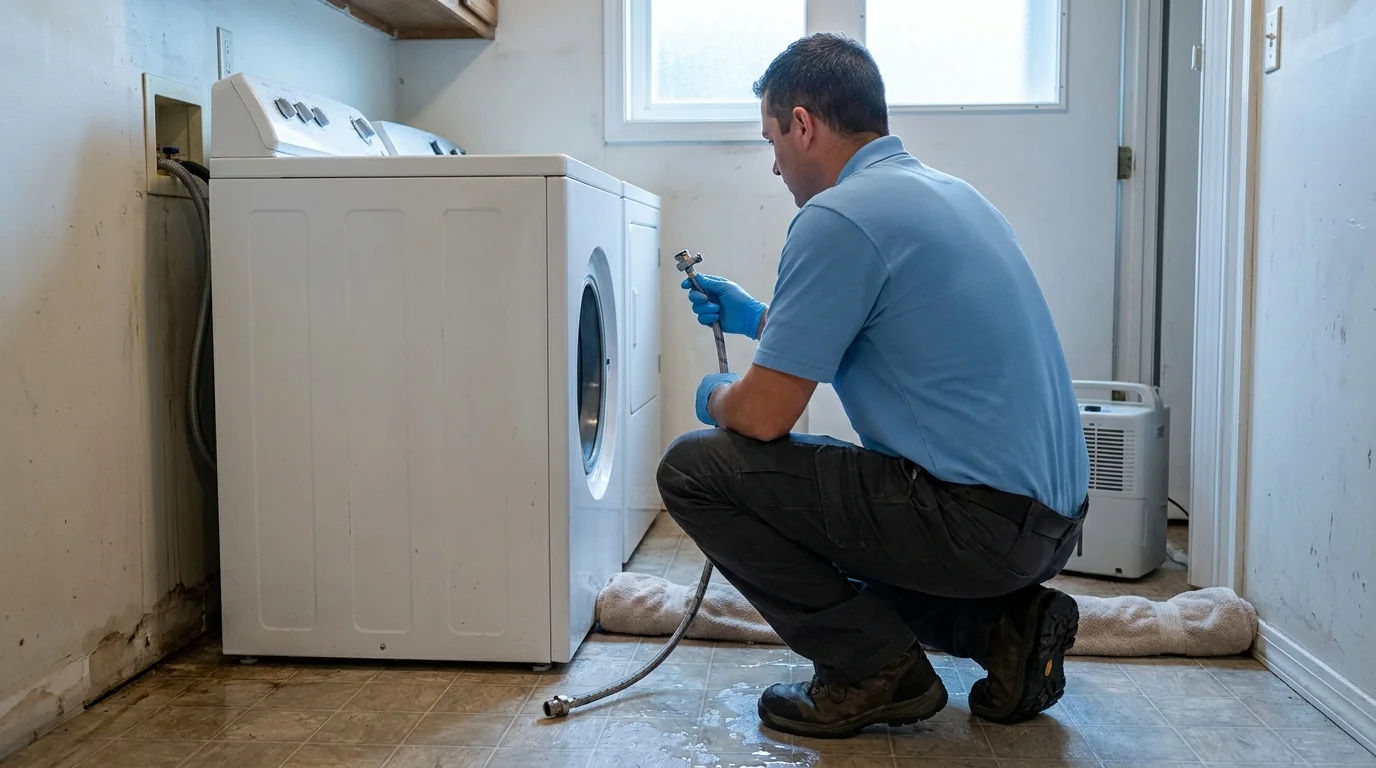
Appliance Leak Cleanup in Staten Island
24/7 appliance leak cleanup in Staten Island, NY. IICRC-certified, insurance billing accepted. Call (855) 650-7422.
Our IICRC-certified technicians are dispatched from our Fair Lawn, NJ headquarters and are typically on-site in Staten Island within 60 minutes of your call.
A refrigerator ice maker line that drips for weeks behind a postwar Cape Cod in Great Kills can saturate a plywood subfloor long before the homeowner notices a soft spot underfoot. Staten Island’s dense housing stock, packed with mid-century split-levels, early-1900s frame homes, and newer townhome clusters, means appliance leaks rarely stay contained to one surface. Water follows the path of least resistance through aging floor assemblies, into crawlspaces, and along cast-iron drain lines that have been flexing and corroding since the Eisenhower administration. When your dishwasher, washing machine, water heater, or refrigerator line gives out, the window between a manageable cleanup and a mold problem is measured in hours, not days.
Why Staten Island Homes Are Especially Vulnerable to Appliance Leaks
The borough’s housing history works against you when an appliance fails. Homes built before 1960, and there are thousands of them between Port Richmond and New Dorp, were constructed with subfloor assemblies and wall cavities that weren’t designed around modern appliance loads. A washing machine on the second floor of a 1940s frame house in St. George sits above tongue-and-groove boards that can wick moisture laterally for several feet before showing any surface staining. By the time you see a water mark on the ceiling below, the structural cavity has already been wet for days.
Supply line materials compound the problem. Braided stainless lines have replaced the old rubber hoses in newer installs, but plenty of Staten Island homes still run original rubber supply lines to dishwashers and washing machines, lines that can fail suddenly after years of vibration stress. Refrigerator ice maker lines, often quarter-inch plastic tubing run through finished cabinetry, are particularly prone to slow pinhole leaks that go undetected until a cabinet base is visibly warped.
The borough’s basement prevalence matters too. Whether you’re in a split-level off Hylan Boulevard or a detached home near Historic Richmond Town, there’s a good chance your water heater sits in a finished or semi-finished basement. A water heater failure, especially a slow tank weep, can saturate concrete slab edges, migrate under vinyl flooring, and create the warm, damp conditions mold needs to colonize within 24 to 48 hours.
Our Appliance Leak Cleanup Process in Staten Island
The first thing we do on arrival is identify the moisture boundary, not just the visible wet area, but the full extent of saturation using thermal imaging cameras and calibrated moisture meters. Appliance leaks are deceptive: a dishwasher leak that appears limited to the kitchen often tracks under the toe-kick, into the adjacent cabinet run, and through the subfloor into the space below. We map all of it before any material comes out.
Once the scope is confirmed, we extract standing water with truck-mounted or portable extraction units, then begin the drying phase using commercial-grade desiccant or refrigerant dehumidifiers and high-velocity air movers positioned to create directed airflow through wall cavities and floor assemblies. In Staten Island’s older frame homes, where subfloor boards are thicker and denser than modern OSB, drying timelines can run longer, we set equipment, monitor moisture readings daily, and don’t call a job dry until meter readings confirm it, not just because the surface feels dry to the touch.
Affected materials, saturated drywall, swollen cabinet bases, compromised flooring, are removed only where necessary to achieve drying goals and documented photographically for your insurance claim. We work to the IICRC S500 standard for water damage restoration throughout the process.
Reaching Staten Island from Our Base
The Restoration Group maintains crews available around the clock, and Staten Island is a regular service area from our operations base. Depending on traffic on the Goethals Bridge or the Bayonne Bridge approach, crews can reach ZIP codes like 10306 and 10312, covering the South Shore and mid-island neighborhoods, for emergency dispatch. We call ahead when routing to addresses near the Staten Island Ferry Terminal area or through the congested stretch of Forest Avenue, where commercial claims along the retail corridor can occasionally require coordinated staging.
Staten Island Insurance Coordination for Appliance Leaks
Sudden and accidental appliance discharge is among the most commonly covered water loss categories under standard homeowners policies, but documentation quality determines how smoothly a claim moves. We photograph moisture readings, affected materials, and equipment placement at every stage, and we provide your adjuster with a scope of loss that reflects actual drying progress rather than estimates. For townhome and condo owners in newer developments, there are several clusters in the 10314 ZIP code, we also help clarify the line between unit-owner coverage and HOA master policy responsibility, which frequently comes up when a washing machine leak affects a shared wall or the unit below.
Local Note
In Staten Island’s postwar Cape Cods and split-levels, finished basements often have a layer of vinyl floor tile, sometimes original 9-inch asbestos-containing tile from the 1950s and 60s, installed directly over the concrete slab. When a water heater or washing machine leak saturates that floor assembly, disturbing the tile without proper testing can create a regulatory issue that delays the entire job. We flag this condition early in the assessment and, where tile testing is warranted, coordinate with a qualified industrial hygienist before any mechanical removal begins, keeping the project on track and the homeowner out of liability.
If an appliance leak has left standing water, soft flooring, or a persistent damp smell anywhere in your Staten Island home, call The Restoration Group at (855) 650-7422. We’re available 24/7, and the sooner the moisture boundary is mapped, the more of your home’s structure and finishes can be saved.
Serving Staten Island from our Fair Lawn headquarters — ★ 4.8 · 160 Google reviews
“(Translated by Google) Excellent work. The staff were responsible, friendly, and above all, very clean. I was very satisfied and I recommend them 100%. (Original) Excelente trabajo.el personal responsables,amables y sobre todo muy limpios para trabajar .quedé satisfecha y lo recomiendo al 💯.” — Dessy, September 2026Read our reviews on Google →
Appliance Leak Cleanup in Staten Island: Service Coverage
Frequently Asked Questions
How fast can you arrive for appliance leak cleanup in Staten Island?
How quickly can The Restoration Group reach a home in Great Kills or the South Shore for an appliance leak emergency?
Are the older frame homes in St. George and Port Richmond harder to dry out after a washing machine flood?
My refrigerator ice maker line leaked slowly for weeks in my New Dorp home — is that a bigger problem than a sudden flood?
Does Staten Island's older housing stock increase the chance that a water heater leak involves asbestos-containing materials?
Will my homeowners insurance cover a dishwasher leak cleanup in a Staten Island townhome, and how do you handle documentation?
Appliance Leak Cleanup response in Staten Island
Most Staten Island calls see a technician on-site within 60 minutes from our Fair Lawn headquarters.