24/7 Emergency Fire Damage Restoration in Staten Island
24/7 emergency fire damage restoration in Staten Island, NY. IICRC-certified, insurance billing accepted. Call (844) 808-8838.
Our IICRC-certified technicians are dispatched from our Fair Lawn, NJ headquarters and are typically on-site in Staten Island within 60 minutes of your call.
Fire damage emergency in Staten Island? We answer 24/7. Call now and our crew can be on-site within 60 minutes to secure the property and start the recovery.
Fire damage in a Staten Island home doesn’t stay contained to one room for long. Between the borough’s older frame construction and the salt-heavy air rolling in off the Lower Bay, soot and smoke odor spread fast and cling to surfaces in ways that surprise homeowners used to thinking of fire damage as just the burned room. Whether it’s a kitchen fire in a New Dorp Cape Cod or an electrical fire in a Port Richmond two-family, the cleanup has to move quickly before soot residue etches into finishes and smoke odor works its way into subfloors and wall cavities.
Why Staten Island Properties See Fire Damage Spread Fast
A lot of Staten Island’s housing stock works against containment. Early-1900s frame homes in areas like St. George were often built with balloon framing, where wall cavities run uninterrupted from basement to attic. That construction style lets fire, heat, and smoke travel vertically through the walls far faster than in a home with modern fire-blocking, which is why a contained kitchen fire can still leave soot staining on a second-floor ceiling. The borough’s dense postwar Cape Cods and split-levels bring a different problem: original electrical panels and knob-and-tube remnants that are more prone to arcing and overheating, especially in homes that have added window units, finished basements, or converted attics without a full panel upgrade. On the commercial side, the Hylan Boulevard and Forest Avenue retail corridors see their own pattern: sprinkler discharge after a fire suppression event often causes more standing water damage than the fire itself, turning a fire call into a combined fire-and-water job.
Our Fire Damage Restoration Process in Staten Island
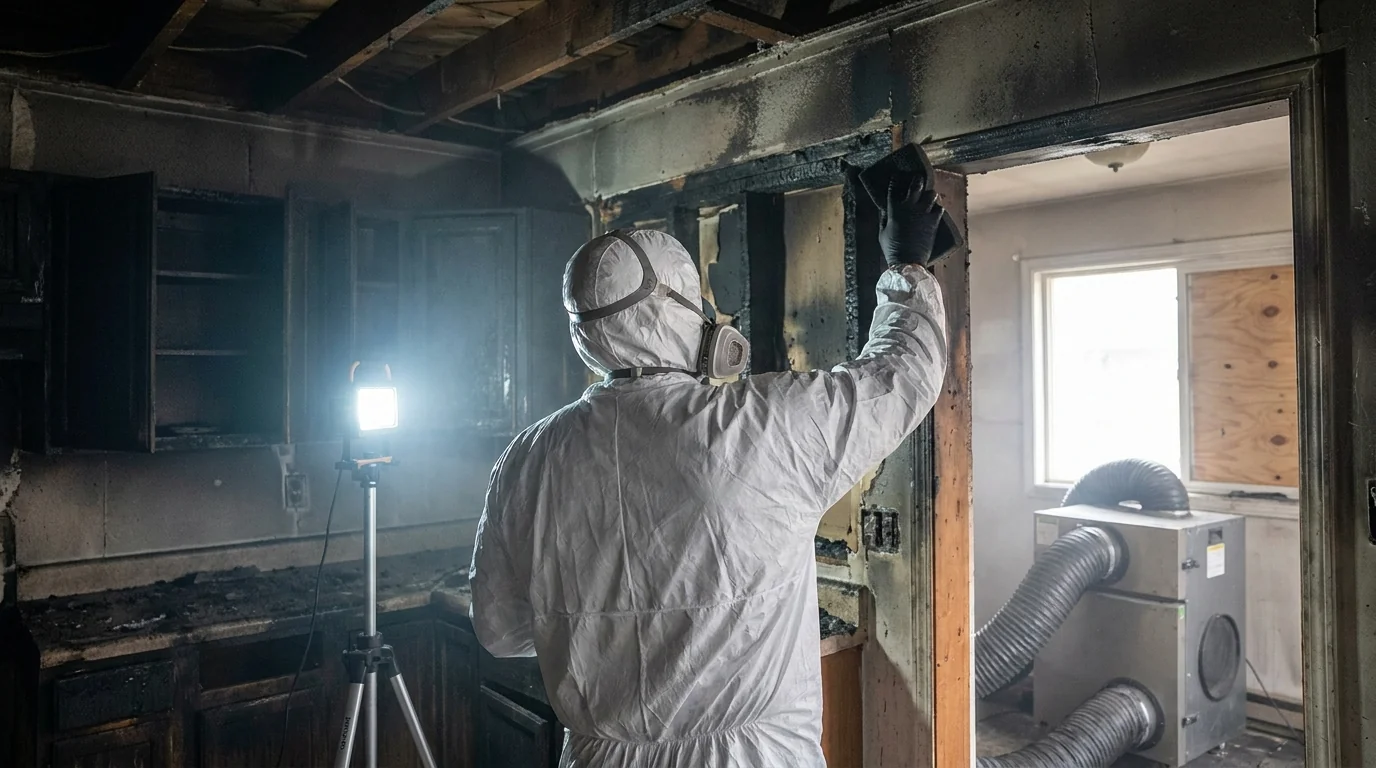
We start with board-up and tarping on any compromised windows, doors, or roof sections, both to secure the property and to stop wind-driven rain, which matters on an island where coastal storms roll through with little warning. From there, soot and residue are classified by the type of fire (protein, synthetic, or complex) because each requires a different cleaning agent and sequence; using the wrong approach on protein residue, for instance, can actually set the odor deeper into porous materials. Structural drying follows if firefighting operations left standing water in the basement or crawlspace, which is common in homes near New Dorp and Great Kills where below-grade spaces already run damp. Content cleaning, air scrubbing, and thermal fogging or ozone treatment (depending on the material and occupancy timeline) address the smoke odor that lingers in soft goods, HVAC ductwork, and framing long after the visible soot is gone.
Staten Island Insurance Coordination
Fire claims on the island often involve two carriers at once, the homeowner’s policy and, in attached or semi-attached properties common in Port Richmond and St. George, a neighboring unit’s policy if shared walls or a shared roofline were affected. We document room-by-room damage with photos and moisture readings before any demolition begins, which carriers expect for both covered-loss and additional-living-expense claims. Any exterior board-up or structural work also needs to account for standard NYC Department of Buildings permitting on affected properties, so we flag early whether a job is likely to need more than emergency stabilization.
Local note
Homes within a few blocks of South Beach and the East Shore carry a secondary complication after a fire: the same salt air that corrodes exterior metal accelerates corrosion on soot-covered appliances, electrical fixtures, and HVAC coils if cleaning is delayed. On these properties we prioritize metal surface cleaning and corrosion inhibitors earlier in the process than we would further inland, because 48 hours of salt-air exposure on top of soot residue can turn a cleanable fixture into a replacement.
If your Staten Island property has fire or smoke damage, from a single-room kitchen fire in Tottenville to a multi-unit loss near Snug Harbor, call The Restoration Group at (844) 808-8838. We answer 24/7, document the loss for your insurance carrier, and clean per the IICRC S740 fire and smoke restoration standard so nothing gets missed between the visible damage and what’s hiding in the walls.
Serving Staten Island from our Fair Lawn headquarters — ★ 4.8 · 171 Google reviews
“We would like to take this moment to commend the professionalism and high quality work delivered by The Group. Having fortunately never dealed with a flood in the past this was all very much new to us. They worked with great care protecting our furniture and ensuring all of our goods were…” - Harry, November 2026Read our reviews on Google →
Fire Damage Restoration in Staten Island: Service Coverage
Frequently Asked Questions
How fast can you arrive for fire damage restoration in Staten Island?
Does balloon framing in older St. George homes change how fire damage restoration is handled?
Are homes near South Beach more prone to damage after a fire?
What equipment do you use to remove smoke odor after a fire?
How does New York City permitting affect fire damage work in Staten Island?
Do you coordinate with insurance for fire claims on attached or semi-attached Staten Island homes?
Fire Damage Restoration response in Staten Island
Most Staten Island calls see a technician on-site within 60 minutes from our Fair Lawn headquarters.
Nearby & Related
- 24/7 Emergency Fire Damage Restoration in Kenilworth
- Restoration Services in Staten Island
- Mold Remediation in Staten Island
- 24/7 Emergency Water Damage Restoration in Staten Island
- 24/7 Emergency Fire Damage Restoration in Bayonne
- 24/7 Emergency Fire Damage Restoration in Bloomfield
- Contact The Restoration Group