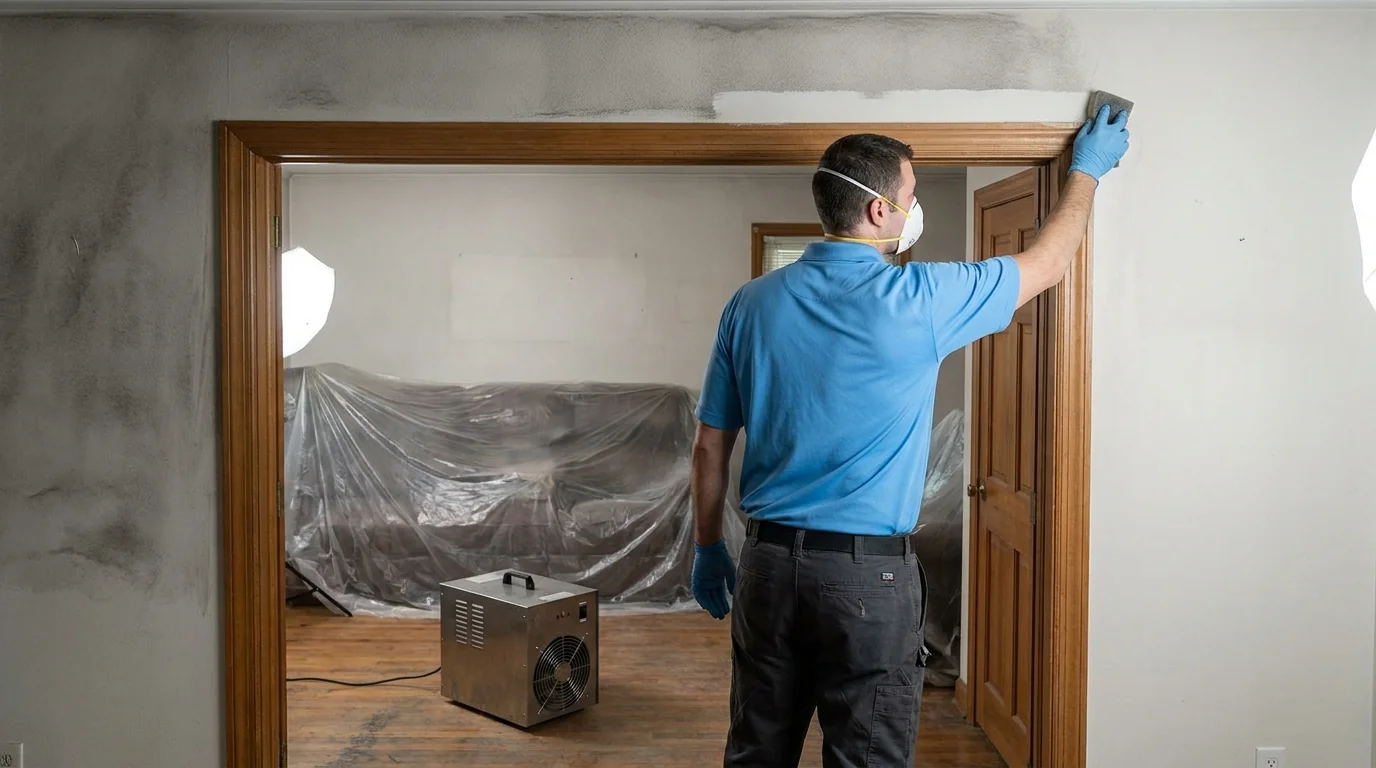
Smoke Damage Restoration in Wayne
24/7 smoke damage restoration in Wayne, NJ. IICRC-certified, insurance billing accepted. Call (855) 650-7422.
Our IICRC-certified technicians are dispatched from our Fair Lawn, NJ headquarters and are typically on-site in Wayne within 60 minutes of your call.
Wayne’s older housing stock carries a specific risk that most homeowners don’t think about until a fire happens: the same tight construction that makes a 1960s Packanack Lake split-level feel solid also traps smoke and combustion byproducts deep inside wall cavities, HVAC ductwork, and the porous concrete block foundations common throughout 07470. When a kitchen fire or electrical event sends smoke through a home, the odor and residue don’t stay in the room where the flames were, they migrate, and in Wayne’s midcentury homes, they migrate fast and far.
Why Wayne Properties See Smoke Damage Differently
The housing stock around Pines Lake, Packanack Lake, and the Preakness corridor was built largely between 1950 and 1975, during an era when interior finishes leaned heavily on plaster-and-lath walls, knotty pine paneling, and asbestos-containing ceiling tiles. These materials absorb smoke particulates and acidic soot at a different rate than modern drywall. Plaster is alkaline and can partially neutralize acidic smoke residue on the surface, but that same porosity means odor-causing volatile organic compounds penetrate deeper into the substrate. A surface wipe-down that would work on a 2010 colonial simply doesn’t reach the contamination layer in a 1962 ranch.
Wayne also sits in a climate zone that amplifies the problem. Passaic County summers bring high humidity, often 70–80% relative humidity through July and August, which reactivates dried smoke residue, releasing odor months after a fire if the initial restoration was incomplete. Homes near the lake communities, where ambient moisture is even higher, are especially prone to this cycle.
Our Smoke Damage Restoration Process in Wayne
Every job starts with a room-by-room assessment that maps smoke migration paths, not just the origin room. In Wayne’s split-levels and bi-levels, smoke commonly travels through the HVAC return system into finished lower levels and attached garages before anyone notices. We use thermal imaging and air sampling to trace that path before a single surface is cleaned.
From there, the process follows the IICRC S700 standard for smoke and fire restoration:
- Dry soot removal first. Vacuuming and dry-sponge wiping removes loose particulates before any wet cleaning. Introducing moisture to dry soot smears it into porous surfaces and makes removal significantly harder.
- Chemical sponge and detergent cleaning on walls, ceilings, and hard surfaces, with product selection based on soot type, protein residue from kitchen fires requires enzymatic cleaners; synthetic-material soot from electrical or structural fires responds to alkaline degreasers.
- HVAC and ductwork decontamination. In Wayne’s older forced-air systems, duct interiors accumulate smoke residue that will re-circulate odor every time the system runs. We clean and seal duct surfaces as part of the scope, not as an add-on.
- Thermal fogging and hydroxyl treatment for persistent odor in wall cavities and subfloor spaces, particularly in homes with finished basements where smoke has settled into carpet padding and wood framing.
- Content pack-out and cleaning for salvageable furnishings, clothing, and documents, coordinated with your insurance adjuster’s inventory.
Reaching Wayne from Kenilworth
The Restoration Group’s base in Kenilworth puts Wayne roughly 25–30 minutes out via I-287 North under normal traffic conditions, a straightforward run that holds up well outside peak commute hours. For addresses in the Mountain View section or near High Mountain Park Preserve on the township’s western edge, we route via Route 23 North from I-287, which typically adds only a few minutes. Because our crews are available around the clock, we can dispatch and be on-site before secondary smoke damage, the acidic etching of metal fixtures, the yellowing of painted surfaces, progresses further than it already has.
Wayne Insurance Coordination
Smoke damage claims in Wayne follow standard homeowners policy structures, but the age of the housing stock creates documentation nuances worth knowing. Adjusters frequently flag pre-existing conditions in older homes, a cracked chimney flue, aging HVAC components, as potential coverage disputes. We photograph and document the pre-loss condition of affected materials at intake, separating fire-related damage from wear-and-tear in a format that holds up in the claims process. We bill most major carriers directly and can provide your adjuster with the scope of work, line-item pricing, and moisture or air-quality readings that support the claim.
Local Note
In Wayne’s lake-community homes, particularly the ranches and split-levels ringing Pines Lake and Lionshead Lake, finished basements are almost universal, and many were converted decades ago using wood-paneled walls and drop ceilings that were never designed to be smoke-exposed. When a fire or heavy smoke event occurs on the main floor, that finished lower level acts like a collection chamber: smoke drops as it cools, and the paneling and ceiling tiles absorb odor compounds that standard cleaning won’t reach. On these properties, we routinely plan for partial material removal and replacement of the drop-ceiling grid and tiles as part of the smoke restoration scope, not because the materials are visibly charred, but because the odor load makes salvage impractical.
If your Wayne home or business has been through a fire, whether a contained kitchen incident or a larger structural event, call The Restoration Group at (855) 650-7422. We’ll assess the full extent of smoke migration, document everything your insurance carrier needs, and restore the property to a condition where the air quality matches what it was before the fire.
Serving Wayne from our Fair Lawn headquarters — ★ 4.8 · 160 Google reviews
“(Translated by Google) Excellent work. The staff were responsible, friendly, and above all, very clean. I was very satisfied and I recommend them 100%. (Original) Excelente trabajo.el personal responsables,amables y sobre todo muy limpios para trabajar .quedé satisfecha y lo recomiendo al 💯.” — Dessy, September 2026Read our reviews on Google →
Smoke Damage Restoration in Wayne: Service Coverage
Frequently Asked Questions
How fast can you arrive for smoke damage restoration in Wayne?
How does the age of homes in Packanack Lake and Pines Lake affect smoke damage restoration timelines?
Can smoke odor return months after a fire in Wayne's humid summers?
Does Wayne's ZIP code 07470 have any code or permit requirements that affect smoke damage repair work?
What's the difference between smoke damage from a kitchen fire versus an electrical or structural fire in a Wayne home?
Will my homeowners insurance cover smoke damage restoration in Wayne, and how does The Restoration Group help with the claim?
Smoke Damage Restoration response in Wayne
Most Wayne calls see a technician on-site within 60 minutes from our Fair Lawn headquarters.