Fire Damage Restoration in Wayne
24/7 fire damage restoration in Wayne, NJ. IICRC-certified, insurance billing accepted. Call (855) 650-7422.
Our IICRC-certified technicians are dispatched from our Fair Lawn, NJ headquarters and are typically on-site in Wayne within 60 minutes of your call.
Wayne’s older housing stock carries a fire risk profile that most homeowners don’t think about until it’s too late. The 1950s and 1960s colonials and split-levels that line the streets near Packanack Lake and Pines Lake were built before modern fire-stop blocking became code, meaning a kitchen fire can travel through wall cavities faster than it would in a newer home, and smoke can saturate insulation and framing in areas that look untouched from the outside. When that happens, the cleanup is never just about what burned.
Why Wayne Properties See Elevated Fire Damage Challenges
The same midcentury construction that gives Wayne its character creates specific complications after a fire. Balloon-frame walls, common in colonials built before the mid-1970s, allow heat and smoke to travel vertically from basement to attic without the fire-blocking that platform framing provides. Finished basements, standard in the lake-community homes around Pines Lake and Lionshead Lake, often contain HVAC equipment that distributes smoke odor into every room within minutes of ignition.
Wayne’s climate adds another layer. Passaic County winters are cold and damp, and homes that have already dealt with moisture intrusion, a real pattern in the ZIP code 07470 corridor near the river floodplains, often have compromised insulation or subflooring that absorbs smoke residue more deeply than dry materials would. Fire restoration in a home that has seen prior water damage requires careful assessment before any drying or deodorization begins, because the two loss types interact in ways that affect the final scope of work.
Our Fire Damage Restoration Process in Wayne
The first priority after the fire department clears a structure is stabilization. That means boarding windows and doors, tarping any roof penetrations, and documenting every affected surface photographically before a single item is moved. This documentation matters, it becomes the foundation of your insurance claim and protects you if scope disputes arise later.
Once the structure is secured, the work moves in a defined sequence:
- Structural assessment: Identifying compromised load-bearing elements, charred framing, and heat-damaged sheathing. In Wayne’s older colonials, this often includes checking rim joists and balloon-frame cavities that aren’t visible from finished surfaces.
- Contents separation: Salvageable items are inventoried and moved off-site for cleaning; unsalvageable materials are documented before removal.
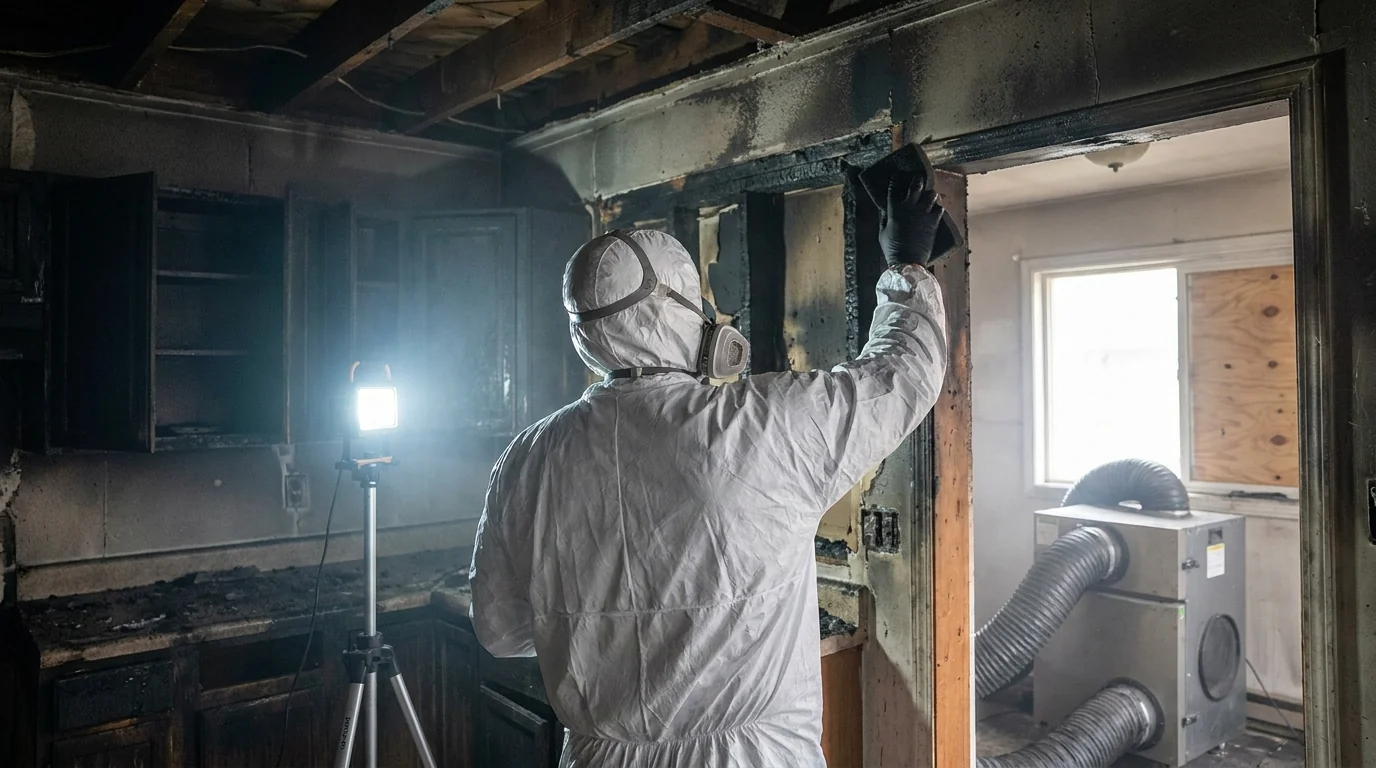
- Smoke and soot removal: Dry-chemical sponging of soot from walls and ceilings before any wet cleaning, reversing this order drives soot deeper into porous surfaces. Thermal fogging and hydroxyl generation address embedded odor in wall cavities and HVAC systems.
- Structural drying: Fire suppression water from sprinklers or hose lines leaves real moisture loads. Drying is conducted per IICRC S500 standards using calibrated desiccant dehumidifiers and air movers.
- Reconstruction scoping: Framing, drywall, insulation, and finish work are scoped to match existing materials, important in Wayne neighborhoods where matching original trim profiles and plaster textures matters for both aesthetics and resale.
Reaching Wayne from Kenilworth
The Restoration Group operates 24/7 out of Kenilworth, NJ. Wayne is accessible via Route 22 West to I-287 North, a route that stays clear outside of peak commute hours. For addresses in the Preakness and Mountain View sections, which sit on the western side of town, the approach via Route 23 North from the I-80 interchange is typically faster. Packanack Lake and Hoffman Grove addresses are best reached via Valley Road or Parish Drive depending on traffic conditions on Hamburg Turnpike.
When you call (855) 650-7422, the intake team will ask for your address and cross street specifically so the responding crew can route efficiently and arrive with the right equipment staged for the job size.
Wayne Insurance Coordination
Most residential fire losses in Wayne go through standard homeowners’ policies, but the claim process has details worth knowing. New Jersey requires insurers to provide advance payment for emergency stabilization work, boarding, tarping, and initial debris removal, without waiting for a full adjuster inspection. That means you don’t have to wait days for an adjuster to approve emergency work that needs to happen now.
For Wayne homeowners in lake communities with HOA governance, some associations require written notification before exterior work begins, even on emergency repairs. The Restoration Group, licensed by the NJ Division of Consumer Affairs as a Home Improvement Contractor, carries the documentation insurers and HOA boards require and can communicate directly with your adjuster to keep the claim moving.
Local Note
Wayne’s lake communities, Packanack, Pines Lake, and Lionshead, were developed largely in the 1950s and early 1960s, and many of the homes still have original knob-and-tube or early aluminum wiring in attic spaces, even if the main panel has been updated. After a fire, this matters because electrical inspectors from the Wayne Township Building Department will often require a full electrical inspection before a certificate of occupancy can be reissued, and that inspection sometimes uncovers pre-existing code violations that weren’t the cause of the fire but still need to be addressed before reconstruction can close out. Crews who haven’t worked in Wayne before sometimes miss this step, which stalls the final CO and delays the homeowner’s return. We flag it at the scoping stage so there are no surprises at the end.
If a fire has damaged your home or property in Wayne, call (855) 650-7422 now. The Restoration Group’s IICRC Certified team responds around the clock, documents everything your insurer needs, and handles the full scope from emergency stabilization through finished reconstruction, so you’re not managing a dozen separate contractors while your home sits open.
Serving Wayne from our Fair Lawn headquarters — ★ 4.8 · 160 Google reviews
“(Translated by Google) Excellent work. The staff were responsible, friendly, and above all, very clean. I was very satisfied and I recommend them 100%. (Original) Excelente trabajo.el personal responsables,amables y sobre todo muy limpios para trabajar .quedé satisfecha y lo recomiendo al 💯.” — Dessy, September 2026Read our reviews on Google →
Fire Damage Restoration in Wayne: Service Coverage
Frequently Asked Questions
How fast can you arrive for fire damage restoration in Wayne?
How quickly can The Restoration Group reach a fire-damaged home in the Packanack Lake or Pines Lake area of Wayne?
Wayne has a lot of older split-levels and colonials — does the age of the home affect how fire damage is restored?
Will Wayne Township require permits and inspections before we can move back in after a structural fire?
What does smoke odor removal actually involve, and how long does it take in a typical Wayne home?
How does the insurance claim process work for fire losses in Wayne, and does The Restoration Group work directly with adjusters?
Fire Damage Restoration response in Wayne
Most Wayne calls see a technician on-site within 60 minutes from our Fair Lawn headquarters.