Basement Flooding Cleanup in Wayne
24/7 basement flooding cleanup in Wayne, NJ. IICRC-certified, insurance billing accepted. Call (855) 650-7422.
Our IICRC-certified technicians are dispatched from our Fair Lawn, NJ headquarters and are typically on-site in Wayne within 60 minutes of your call.
Wayne’s relationship with water is complicated. The Passaic and Pompton Rivers have pushed into the Mountain View and Hoffman Grove sections repeatedly, most memorably during Irene in 2011 and again when Ida dropped seven inches overnight in September 2021, and the lake communities around Packanack Lake and Pines Lake sit on finished basements that were never designed to hold back a storm surge. When a basement floods here, the clock starts immediately: standing water that lingers more than 24 to 48 hours creates conditions where mold can begin colonizing porous materials, and in the midcentury split-levels and ranches common throughout 07470, that means wall framing, insulation, and finished drywall can all be compromised before the water is even gone.
Why Wayne Properties See Basement Flooding So Often
The geography does most of the damage. Wayne’s topography funnels runoff from the Preakness ridge and High Mountain Park Preserve down toward the lower-lying neighborhoods near the rivers and lakes, overwhelming storm drains during heavy rain events. The housing stock compounds the problem. Most of the colonials and capes built through the 1950s, ’60s, and ’70s rely on aging clay tile footer drains and single-pump sump systems, equipment that was sized for the rainfall patterns of fifty years ago, not the increasingly intense nor’easters and remnant hurricanes the region sees now. When a sump pump fails at 2 a.m. during a sustained rain event, the basement can take on several inches of water before anyone notices. Older homes also tend to have cast-iron or galvanized supply lines that corrode from the inside out, producing slow leaks that saturate subfloor assemblies for weeks before a visible flood appears.
Our Basement Flooding Cleanup Process in Wayne
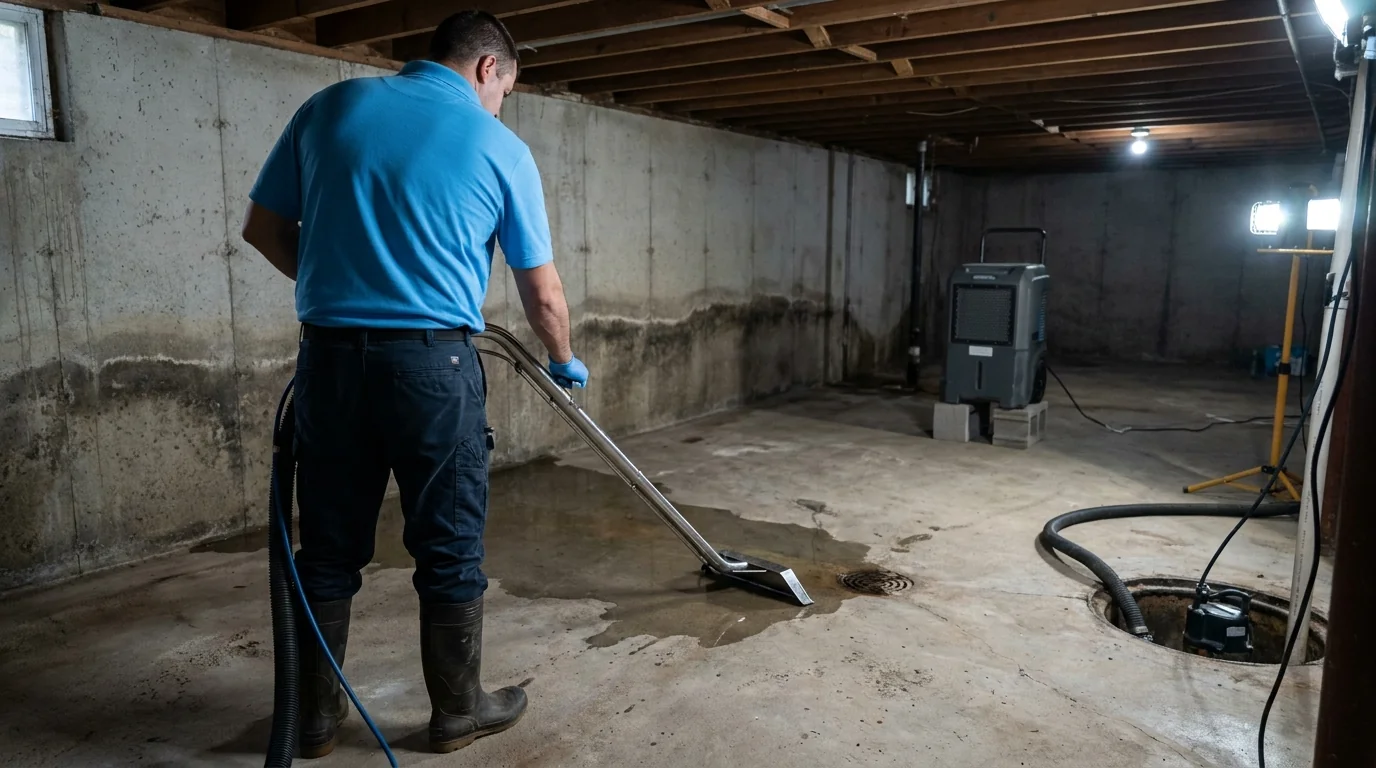
The first step on any flooded basement call is water removal, not assessment, not paperwork. Truck-mounted extraction equipment pulls standing water faster than portable units, which matters in a finished basement where every additional hour of submersion degrades flooring adhesives, swells door frames, and wicks moisture higher into wall cavities. Once bulk water is out, moisture mapping with thermal imaging and calibrated meters identifies where water has traveled beyond the visible wet line. In Wayne’s older homes, that often means water has tracked under slab sections, behind paneling, and into the rim joist cavity above the foundation wall.
Drying is engineered, not estimated. Industrial desiccant and refrigerant dehumidifiers, paired with high-velocity air movers positioned per the IICRC S500 standard, create a controlled drying environment. Daily moisture readings track progress against a drying goal, typically three to five days for a Category 1 water loss in a conditioned basement, longer for Category 2 or 3 losses involving sewage backup or river intrusion. Affected materials that cannot be dried in place, saturated insulation, compromised drywall below the flood line, are removed and documented before reconstruction begins. The Restoration Group is an IICRC Certified Firm (#210213) and a licensed NJ Home Improvement Contractor, so the same crew that extracts and dries can carry the job through rebuild without a handoff.
Reaching Wayne from Kenilworth
The Restoration Group operates out of Kenilworth, and Wayne is reachable around the clock, the team runs 24/7. From Kenilworth, Route 22 West to I-287 North is the most direct path, putting crews into the central Wayne corridor near Wayne Towne Center in under 40 minutes under normal conditions. During a regional storm event, exactly when most calls come in, that route can back up on the 287/Route 46 interchange, and the team will reroute through Route 23 North to reach the Packanack Lake and Pines Lake neighborhoods from the north end of town. Knowing the alternate approach matters when every minute of active flooding adds to the extraction volume.
Wayne Insurance Coordination
Flooding from a storm surge or rising river is typically excluded from standard homeowners policies and falls under separate NFIP flood insurance, a distinction that catches many Wayne homeowners off guard after a Passaic River event. Pipe bursts, sump pump failures covered under a water backup rider, and appliance leaks are generally covered under HO-3 policies. The Restoration Group documents losses with photographs, moisture readings, and material inventories formatted for carrier review, and works directly with adjusters so the claim file reflects actual scope rather than a visual estimate. If your home is in a FEMA-designated flood zone, several streets in the Mountain View and Hoffman Grove sections carry AE or AO designations, the team can help clarify which portions of the loss fall under which policy.
Local Note
One thing that catches crews off guard in Wayne’s lake community homes: the finished basements in the Packanack Lake and Pines Lake neighborhoods were often built with tongue-and-groove wood paneling over furring strips directly against the foundation wall, with no vapor barrier behind them. When those basements flood, the paneling looks intact from the front but the cavity behind it holds standing water and saturated fiberglass batt insulation that will mold within days. Standard moisture meters read the paneling surface and can miss the problem entirely. Thermal imaging is the only reliable way to see what’s happening in that wall assembly before deciding what to open up, and skipping that step leads to callbacks.
If your basement is holding water right now, or you are watching the Passaic River gauge and bracing for what’s coming, call The Restoration Group at (855) 650-7422. The team is available 24/7 and knows Wayne’s neighborhoods, housing stock, and flood patterns well enough to scope the job accurately from the first visit.
Serving Wayne from our Fair Lawn headquarters — ★ 4.8 · 160 Google reviews
“(Translated by Google) Excellent work. The staff were responsible, friendly, and above all, very clean. I was very satisfied and I recommend them 100%. (Original) Excelente trabajo.el personal responsables,amables y sobre todo muy limpios para trabajar .quedé satisfecha y lo recomiendo al 💯.” — Dessy, September 2026Read our reviews on Google →
Basement Flooding Cleanup in Wayne: Service Coverage
Frequently Asked Questions
How fast can you arrive for basement flooding cleanup in Wayne?
Are homes near Packanack Lake and Pines Lake at higher risk for recurring basement flooding?
My home is in the Mountain View section near the Passaic River. Does river flooding change how the cleanup works compared to a pipe burst?
How long does basement drying typically take in Wayne's older colonial and cape-style homes?
Wayne was in a FEMA flood zone after Ida in 2021. Does that affect what my insurance covers for basement water damage?
Can you handle both the water extraction and the reconstruction, or will I need to hire a separate contractor in Wayne?
Basement Flooding Cleanup response in Wayne
Most Wayne calls see a technician on-site within 60 minutes from our Fair Lawn headquarters.