Mold Remediation in Summit
24/7 mold remediation in Summit, NJ. IICRC-certified, insurance billing accepted. Call (844) 808-8838.
Our IICRC-certified technicians are dispatched from our Fair Lawn, NJ headquarters and are typically on-site in Summit within 60 minutes of your call.
Mold Remediation in Summit often starts in a finished basement that never saw standing water, just a damp smell after a wet spring. Summit’s hilltop lots funnel stormwater toward foundations built a century ago, and the plaster and lath behind those basement walls hold moisture long after the surface paint looks dry. By the time a homeowner near Downtown Summit notices the smell, colonization is usually already working through the wall cavity, not just sitting on the surface.
Why Summit Homes Develop Mold
Summit’s elevation keeps it out of the river flooding that hits lower-lying towns nearby, but that same hilltop geography works against it in other ways. Steep lots push rainwater straight at foundation walls instead of away from them, and deep finished basements in the Northside and Franklin School area take on moisture at the sill plate long before anyone sees it upstairs. Original plumbing running inside century-old plaster walls fails quietly, a slow pinhole leak behind a bathroom wall can feed mold for weeks before a stain ever shows. Clay sewer laterals under the mature street trees along blocks near the Brayton School area and the New Providence border are another recurring source, root intrusion causes slow backups that saturate crawl spaces and sill framing. Winter brings its own pattern: uninsulated radiator and supply lines in the older wings of these 1890s-1930s homes freeze and crack inside wall cavities, and the resulting moisture sits trapped behind plaster until someone notices a musty closet or a soft spot in a baseboard.
Our Mold Remediation Process in Summit’s Older Homes
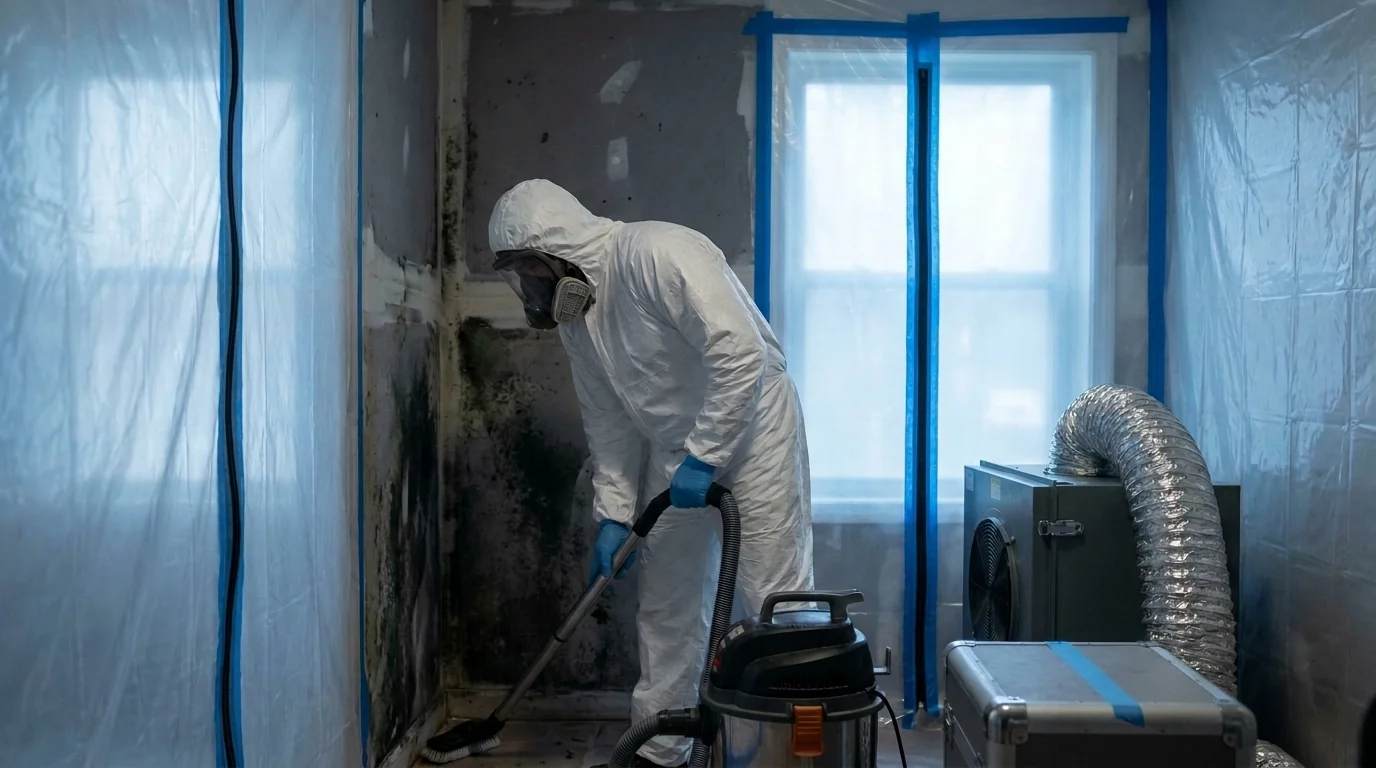
Containment comes first, and in a home with original millwork, plaster ceilings, and finished basements built out for family use, containment has to protect what’s outside the work zone as much as what’s inside it. We build physical barriers and run negative air pressure so spores don’t travel into the rest of the house during removal, which matters more in a deep Summit basement with finished rec rooms than in a simple unfinished crawl space. Moisture mapping comes next, using meters to find how far saturation has traveled through plaster and framing rather than guessing from visible damage alone. Affected materials are removed to the extent the IICRC S520 standard calls for, and anything salvageable, trim, flooring, cabinetry, gets documented and photographed so a homeowner’s contractor has a clear record of original finishes before any wall is opened further. Where a home has significant furniture, rugs, or family contents in the affected area, we handle pack-out and storage separately from the containment zone so nothing absorbs odor or cross-contaminates during the work.
Equipment & Methods We Use
HEPA air scrubbers run continuously inside containment to capture airborne spores, and negative air machines keep pressure flowing inward so nothing escapes into hallways or HVAC returns, which is especially important in homes where ductwork runs through a finished basement ceiling. Antimicrobial treatments are applied to structural framing after removal, and drying equipment stays in place until moisture readings in the plaster and subfloor confirm the space is back to a normal range, not just until it looks dry. On jobs where sewage backup from a failed clay lateral is part of the cause, sanitization follows before any rebuild work begins, since mold and contamination from a lateral failure require different handling than a simple moisture intrusion.
Local note
Homes within a few blocks of the Summit train station and the Springfield Avenue downtown corridor often share tight side yards or party-wall-style proximity, close enough that moisture and musty air can migrate between adjoining structures during extraction. We’ve learned to check the neighboring wall cavity even when only one property reports a problem, because in that part of 07901 a leak on one side of a shared foundation wall doesn’t always stay on one side.
If you’re smelling something musty in a basement near Reeves-Reed Arboretum, noticing a damp wall after a freeze-thaw week, or dealing with a sewer lateral backup that’s left standing moisture behind, Mold Remediation in Summit is worth addressing before it spreads through another season of plaster walls and old framing. Call The Restoration Group at (844) 808-8838 to get a certified team into the house and start moisture mapping before the problem moves further into the structure.
Serving Summit from our Fair Lawn headquarters — ★ 4.8 · 171 Google reviews
“Honest people, super quick and very professional! I recommend them entirely.” - Jennifer, November 2026Read our reviews on Google →
Mold Remediation in Summit: Service Coverage
Frequently Asked Questions
How fast can you arrive for mold remediation in Summit?
How does Summit's older plaster construction change the mold remediation timeline compared to drywall?
Are homes near the New Providence border or Northside more prone to basement mold after storms?
Does Summit zip code 07901 fall within your standard response area from Fair Lawn?
What's involved in protecting original hardwood and millwork during mold containment in a Summit Victorian or Colonial?
Will my homeowner's insurance cover mold remediation caused by a burst pipe inside a Summit home's old plaster walls?
Mold Remediation response in Summit
Most Summit calls see a technician on-site within 60 minutes from our Fair Lawn headquarters.