
24/7 Emergency Flood Damage Restoration in Newark
24/7 emergency flood damage restoration in Newark, NJ. IICRC-certified, insurance billing accepted. Call (844) 808-8838.
Our IICRC-certified technicians are dispatched from our Fair Lawn, NJ headquarters and are typically on-site in Newark within 60 minutes of your call.
Flood damage in Newark rarely waits for a hurricane. A hard summer thunderstorm backing up the combined sewer system, or the Passaic River pushing high during a nor’easter, can put water in a basement in under an hour. If you’re standing in it right now, call (844) 808-8838. We answer 24/7, and the faster extraction starts, the less of the structure and contents you lose.
Why Newark Properties See Flood Damage
Newark sits low in several key spots, and the Ironbound is the clearest example: tight to the Passaic River, with streets that were never regraded for the volume of stormwater the city now sees. When the river runs high or a storm surge pushes in, water finds the path of least resistance, and that’s often a basement window well or a floor drain running backward. Citywide, Newark’s combined sewer system means stormwater and sanitary waste share the same pipes. During heavy rain, that system can surcharge and send contaminated water up through basement drains in Downtown Newark, Vailsburg, and Weequahic alike, not just along the river. Add in the city’s dense pre-war housing stock, brick multifamilies, frame two- and three-families with shared foundation walls, and Forest Hill’s older colonials with original fieldstone or brick foundations, and you get basements that hold water longer and dry slower than anything built after 1980. A failed sump pump or a cracked foundation seam in one of these buildings doesn’t just flood one unit; it can travel along a shared wall and affect a neighbor’s space too.
Our Flood Damage Restoration Process in Newark
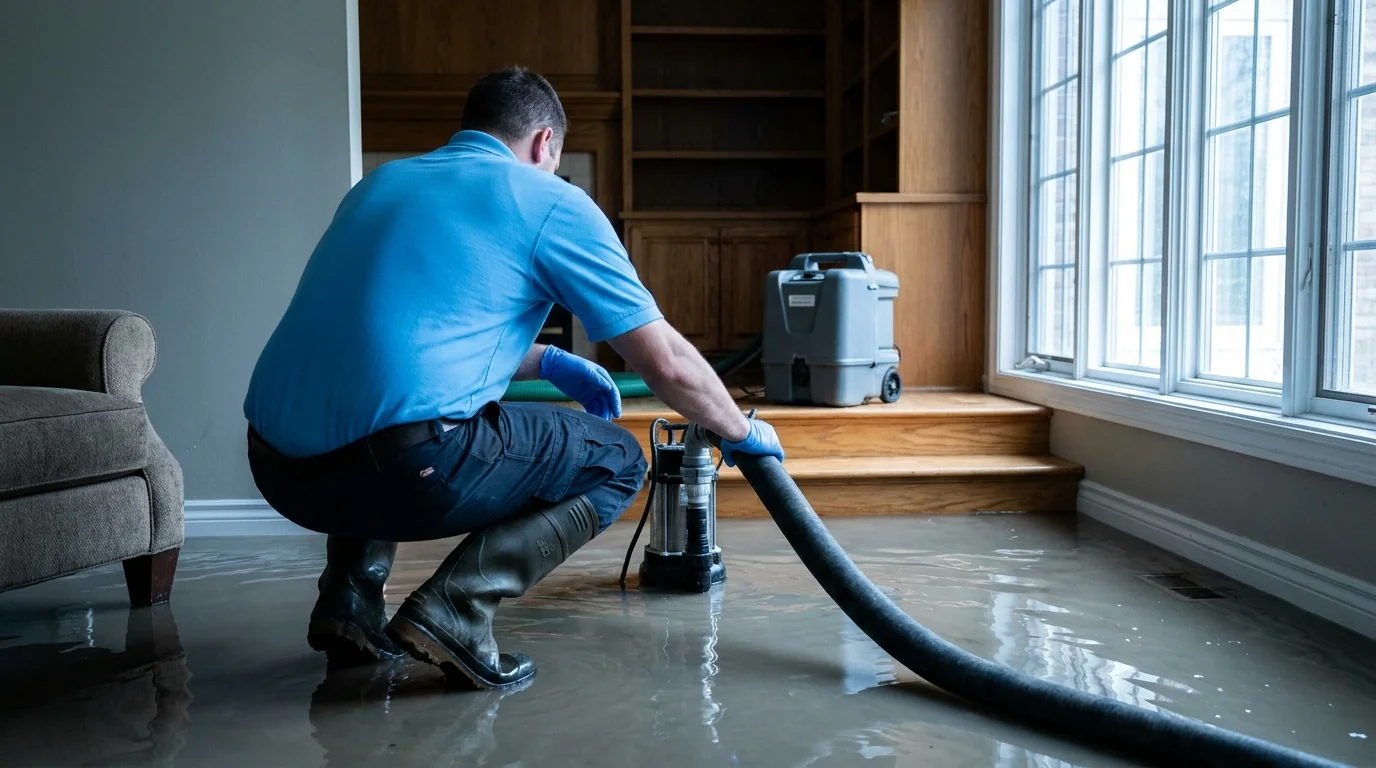
We start with extraction, pulling standing water with truck-mounted and portable pumps before it has time to wick further into plaster, subfloor, or masonry. Because combined sewer backups are common here, we treat any flooding that originated from a drain, floor trap, or sewer cleanout as a contamination risk until proven otherwise, which changes how we handle disposal of saturated materials like carpet pad, drywall, and insulation. Once water is out, we map moisture in walls and flooring with meters rather than guessing, because Newark’s older plaster and brick hold moisture differently than modern drywall, surface-dry fast, but stay wet deep inside for days longer. Drying equipment gets placed and monitored against that reality, not a generic timeline. For multifamily buildings near University Heights or the arena district downtown, we document each affected unit separately so property managers and landlords have a clean, unit-by-unit record for insurance and tenant communication.
Reaching Newark from Fair Lawn
We’re based in Fair Lawn, and Newark is a core part of our Essex County coverage. Depending on the storm, crews route in via Route 21, I-280, or the Garden State Parkway to reach neighborhoods from Forest Hill in the north down through Weequahic near 07108 in the south. Flooding tends to hit multiple parts of the city at once during a major storm event, so we stage equipment and crews ahead of forecasted heavy rain when we can, rather than reacting house by house after the fact.
Newark Insurance Coordination
Most standard homeowner policies exclude flood damage from rising water or storm surge, which trips up a lot of Ironbound and Downtown Newark property owners who assume their regular policy covers it. If the loss came through a sewer backup rider, backup coverage, or a separate flood policy through the National Flood Insurance Program, we document the water’s origin, affected materials, and moisture readings in a way adjusters can actually use, whichever policy ends up paying. For landlords and institutional property managers near the hospital and university corridor or the Prudential Center arena district, we provide unit-level documentation so claims for common areas and individual units don’t get tangled together.
Local Note
In the Ironbound, flood response isn’t just about the Passaic cresting. Tidal influence on the lower river means a heavy rain event that coincides with high tide can hold floodwater in streets and basements longer than the same storm would elsewhere in the city, because gravity drainage slows as the tide pushes back. We factor that tidal timing into how long we expect standing water to persist before extraction equipment can fully keep pace.
If your basement, first floor, or rental unit in Newark has taken on water from a storm, sewer backup, or river flooding, don’t wait to see if it dries on its own. Call (844) 808-8838 for flood damage restoration that starts with extraction and ends with a structure that’s actually dry, not just dry on the surface.
Serving Newark from our Fair Lawn headquarters — ★ 4.8 · 171 Google reviews
“Prompt, knowledgeable, skillful and honest. Highly recommend. They remediated within 24 hours. Total peace of mind restored. Worth every penny.” - Anne, October 2026Read our reviews on Google →
Flood Damage Restoration in Newark: Service Coverage
Frequently Asked Questions
How fast can you arrive for flood damage restoration in Newark?
How does the Ironbound's flood risk affect your restoration approach there?
Newark's combined sewer system backs up during storms. Is that water treated differently?
Do Newark's older frame two- and three-family homes dry differently after a flood?
Will my homeowner's policy cover flood damage in Newark, or do I need separate flood insurance?
How do you handle flood damage in multi-unit buildings near Downtown Newark or the university corridor?
Flood Damage Restoration response in Newark
Most Newark calls see a technician on-site within 60 minutes from our Fair Lawn headquarters.