24/7 Emergency Water Damage Restoration in Manhattan
24/7 emergency water damage restoration in Manhattan, NY. IICRC-certified, insurance billing accepted. Call (844) 808-8838.
Our IICRC-certified technicians are dispatched from our Fair Lawn, NJ headquarters and are typically on-site in Manhattan within 60 minutes of your call.
Water damage emergency in Manhattan? We answer 24/7, and our crews coordinate with building management the moment we’re dispatched. A cracked supply line on a high floor of a Midtown tower or a failed washing machine hose in an Upper West Side pre-war doesn’t just ruin one unit. Gravity does the rest, and water finds its way through plaster, around pipe chases, and into the ceilings of every apartment below before anyone upstairs even notices the leak.
Why Manhattan Properties See Water Damage Issues
Manhattan’s building stock works against you in a water loss. Pre-war co-ops on the Upper East Side and in Harlem still run original cast-iron risers and radiator systems that corrode from the inside, often failing without warning. Newer condo towers in Chelsea and the Financial District concentrate plumbing into shared vertical chases, so a single failed fitting on one floor can wick water through multiple units below in under an hour. Street-level and basement commercial spaces, common in the Lower East Side and around Grand Central Terminal, flood from both ends: storm surge and heavy rain overwhelming storm drains from the street side, and aging supply lines failing from inside. Hurricane Sandy’s surge into the Financial District and Lower East Side, and the drain overload Ida caused from Harlem to Chelsea, both showed how fast Manhattan’s mix of old infrastructure and dense below-grade space turns a storm event into standing water in basements, lobbies, and mechanical rooms.
Our Water Damage Restoration Process in Manhattan
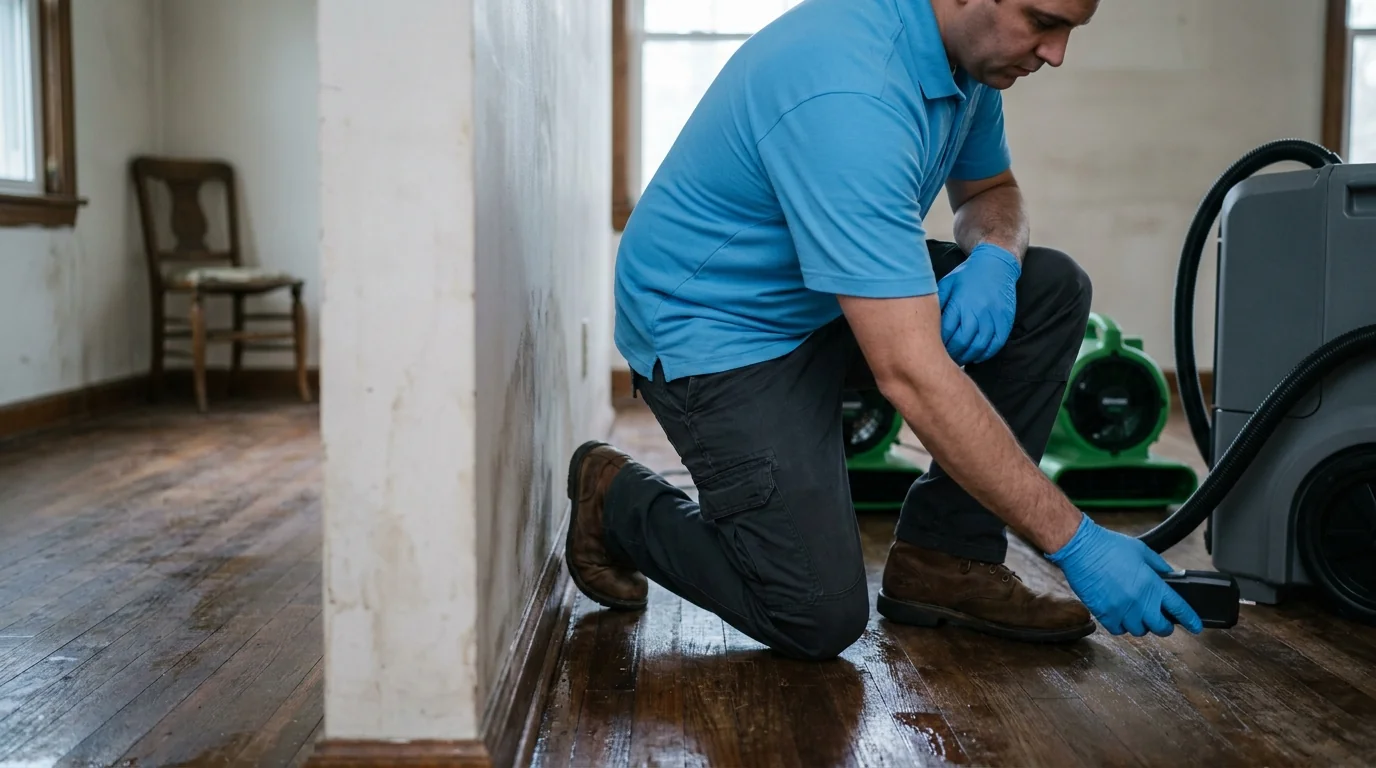
We start with extraction, pulling standing water from floors, carpet pad, and any below-grade mechanical or storage space before moisture migrates further into subfloor and framing. In pre-war buildings with plaster and lath, we test moisture behind the wall assembly rather than relying on surface readings, since plaster can look dry at the face while the lath behind it stays saturated for days. Drying equipment gets placed based on the unit layout and the building’s electrical capacity, since older panels in walk-ups don’t always handle a full bank of air movers without circuit planning. Throughout the job we log moisture readings unit by unit, which is the documentation managing agents and resident managers ask for before signing off on access or closing a claim file.
Manhattan Insurance & HOA Coordination
Co-op boards, condo associations, and managing agents all have their own version of the same requirement: a certificate of insurance before a crew sets foot past the lobby. We carry that documentation to every Manhattan job and build the paperwork trail boards expect, including unit-by-unit drying logs and photos for the building’s file as well as the resident’s insurance claim. Freight elevator access is its own coordination problem in high-rises, many buildings restrict equipment moves to certain hours or require a building engineer present, and we schedule around that rather than showing up and hoping the loading dock is open. For ground-floor retail and restaurant spaces near Times Square or along commercial corridors in Chelsea, we treat overnight mitigation as the priority since every closed business day is lost revenue on top of the physical damage.
Local note
In Manhattan high-rises, the building’s own water shutoff isn’t always where a homeowner expects it. Many towers meter and valve water by floor or by riser zone rather than by individual unit, which means isolating a leak sometimes requires the superintendent to shut down a whole vertical line serving several apartments, not just the one with the burst pipe. We coordinate with building staff on this immediately so the leak gets isolated fast without cutting water to units that don’t need it.
Water moving through a Manhattan building doesn’t wait for a convenient hour, and neither should the response. Whether it’s a riser failure in a Midtown tower, a radiator valve leak on the Upper West Side, or flooding in a Financial District basement, call (844) 808-8838 and we’ll get a crew moving on your water damage restoration.
Serving Manhattan from our Fair Lawn headquarters — ★ 4.8 · 171 Google reviews
“Prompt, knowledgeable, skillful and honest. Highly recommend. They remediated within 24 hours. Total peace of mind restored. Worth every penny.” - Anne, October 2026Read our reviews on Google →
Water Damage Restoration in Manhattan: Service Coverage
Frequently Asked Questions
How fast can you arrive for water damage restoration in Manhattan?
How does a leak on a high floor affect units below in Manhattan buildings?
Do you work with co-op boards and managing agents on water damage jobs?
Are pre-war buildings in neighborhoods like the Upper East Side harder to dry out?
Can you coordinate freight elevator access for a water damage job in a Midtown or Chelsea high-rise?
What should a ground-floor retail space near Times Square expect during water mitigation?
Will my homeowners insurance cover water damage restoration in Manhattan?
Water Damage Restoration response in Manhattan
Most Manhattan calls see a technician on-site within 60 minutes from our Fair Lawn headquarters.