24/7 Emergency Sewage Cleanup and Sanitization in Manhattan
24/7 emergency sewage cleanup and sanitization in Manhattan, NY. IICRC-certified, insurance billing accepted. Call (844) 808-8838.
Our IICRC-certified technicians are dispatched from our Fair Lawn, NJ headquarters and are typically on-site in Manhattan within 60 minutes of your call.
Raw sewage in a high-rise is a different emergency than sewage in a single-family basement. When a stack line backs up on an upper floor in a Midtown or Upper West Side building, contaminated water doesn’t stay put, it travels down risers, saturates ceilings below, and reaches finished units that had nothing to do with the original failure. The Restoration Group handles sewage cleanup and sanitization across Manhattan’s co-ops, condo towers, and commercial ground floors, working inside the access and documentation rules those buildings require.
Why Manhattan Buildings See Sewage Backups
Much of Manhattan’s plumbing infrastructure predates modern code, and vertical stacks carrying waste from dozens of units down to a single sewer lateral are a common point of failure. A clog or collapsed section in a pre-war building’s cast iron stack can send sewage backward into lower units rather than down to the street, and because many buildings share a single lateral connection to the city sewer, a blockage anywhere in that line affects every stacked unit above it. Storm surge is a separate but related risk: Sandy pushed sewage-contaminated floodwater into basements and ground-floor mechanical rooms across the Financial District and Lower East Side, and heavy rain events like Ida have overwhelmed aging combined sewer lines as far north as Harlem and Chelsea, backing sanitary waste into low-lying units during peak storm flow.
Our Sewage Cleanup and Sanitization Process
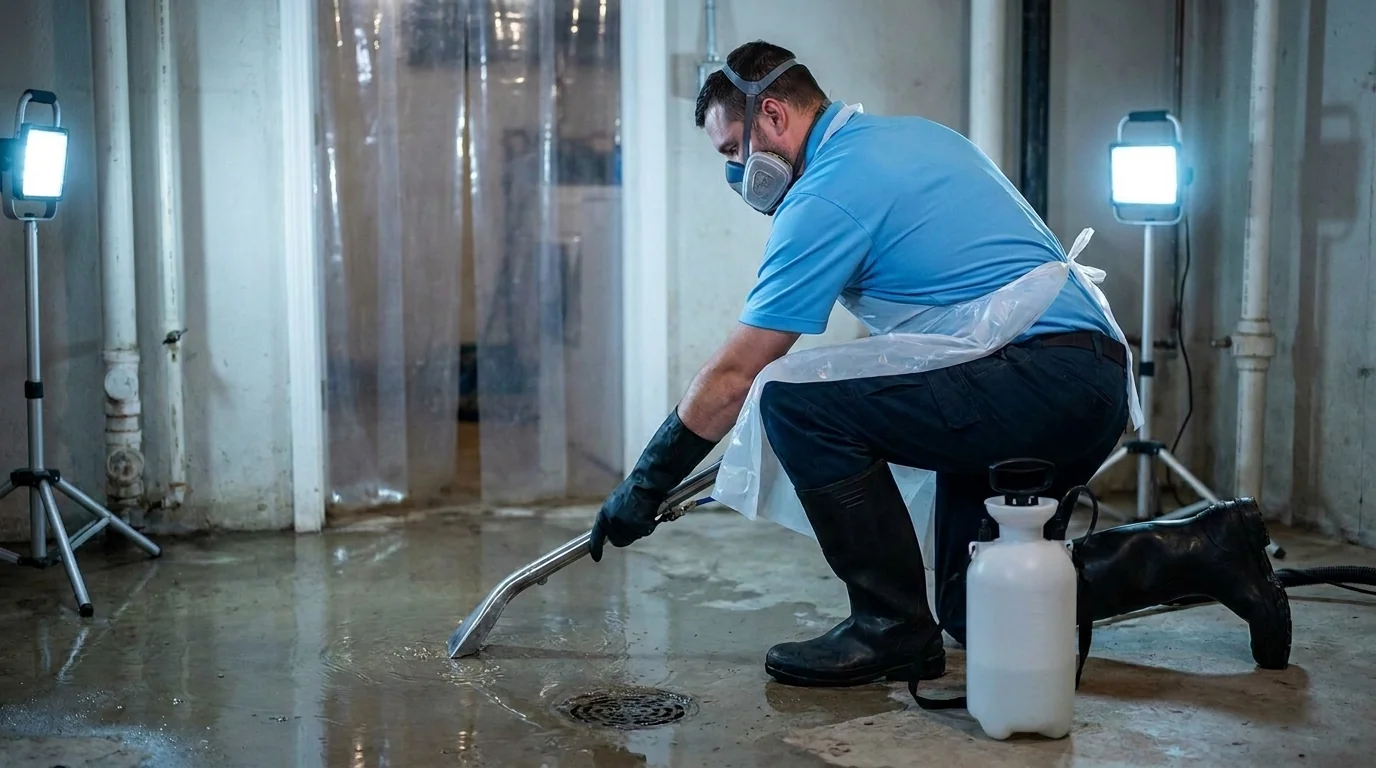
We start by identifying the contamination category and shutting off the source where the building’s engineer or super gives access. Standing sewage and saturated porous materials, carpet pad, baseboard, drywall below the flood line, are removed rather than cleaned, since category 3 water cannot be safely dried in place. Remaining structural materials are cleaned, treated with EPA-registered antimicrobials, and dried following IICRC S500 guidelines, with moisture logged room by room so the building’s managing agent has a written record for every affected unit. In towers where a leak on one floor has soaked the ceiling below, we document and dry both the source unit and the exposed unit underneath before closing out either one.
Manhattan Insurance & HOA Coordination
Co-op boards and condo managing agents in Manhattan typically require a certificate of insurance before a crew steps on site, along with advance notice to book the freight elevator and a unit-by-unit moisture log for the building’s file. We build those requirements into scheduling up front rather than treating them as paperwork after the fact, which keeps a sewage loss from stalling in the lobby while residents wait. For co-op shareholders and condo owners, we document the loss and affected materials in a format carriers and building management both accept, which helps separate what the resident’s policy covers from what falls under the building’s master policy.
Local note
In Manhattan’s older multi-family stacks, a sewage backup rarely stays on one floor. Because waste risers run vertically through shared chases, a blockage at a lower connection point can push contaminated water up and out through fixtures several floors above the actual clog, so a unit reporting a sewage smell with no visible overflow often isn’t the source of the problem, it’s downstream of one. We trace the stack before we start sanitizing so the actual point of failure gets fixed, not just the symptom.
Sewage exposure in an occupied building needs to be contained fast, and it needs to be handled in a way the board, the managing agent, and the insurance carrier will all accept without a second visit. The Restoration Group is IICRC Certified Firm #210213 and answers calls 24/7 for sewage cleanup and sanitization across Manhattan, from Upper East Side co-ops to Financial District commercial ground floors. Call (844) 808-8838 to get a crew and the right paperwork moving at the same time.
Serving Manhattan from our Fair Lawn headquarters — ★ 4.8 · 171 Google reviews
“Prompt, knowledgeable, skillful and honest. Highly recommend. They remediated within 24 hours. Total peace of mind restored. Worth every penny.” - Anne, October 2026Read our reviews on Google →
Sewage Cleanup and Sanitization in Manhattan: Service Coverage
Frequently Asked Questions
How fast can you arrive for sewage cleanup and sanitization in Manhattan?
How does a sewage backup in a Midtown high-rise get handled differently than a single-family home?
Do Manhattan co-op boards require anything before you can start sewage cleanup?
Are ground-floor and basement units in the Financial District and Lower East Side more exposed to sewage backups during storms?
What materials can't be saved after a category 3 sewage loss?
How do you document a sewage loss for a Manhattan condo's insurance claim?
Sewage Cleanup and Sanitization response in Manhattan
Most Manhattan calls see a technician on-site within 60 minutes from our Fair Lawn headquarters.
Nearby & Related
- 24/7 Emergency Sewage Cleanup and Sanitization in Kenilworth
- Restoration Services in Manhattan
- 24/7 Emergency Fire Damage Restoration in Manhattan
- Mold Remediation in Manhattan
- 24/7 Emergency Sewage Cleanup and Sanitization in Brooklyn
- 24/7 Emergency Sewage Cleanup and Sanitization in Cranford
- Contact The Restoration Group