
24/7 Emergency Storm Damage Restoration in Jersey City
24/7 emergency storm damage restoration in Jersey City, NJ. IICRC-certified, insurance billing accepted. Call (844) 808-8838.
Our IICRC-certified technicians are dispatched from our Fair Lawn, NJ headquarters and are typically on-site in Jersey City within 60 minutes of your call.
Storm damage emergency in Jersey City? We answer 24/7, and crews are dispatched the same hour you call. Whether a nor’easter has pushed the Hudson over its banks near Exchange Place or straight-line winds have dropped a tree limb through a roof in the Heights, the clock on water intrusion starts the moment the storm passes, not when the sun comes out.
Jersey City takes storms differently depending on which part of the city you’re standing in. Around Newport and Exchange Place, floor-to-ceiling glass and shared mechanical risers mean a single roof membrane failure or a flooded parking garage can send water into a dozen units before building management even gets a call. Up in the Heights, Bergen-Lafayette, and Greenville, the housing stock is frame rowhouses and brownstones built between the 1890s and 1920s, many with cellars that sit below the water table. Those cellars flood first and worst during heavy rain events, and the city’s combined sewer system backs up into them when storm flow overwhelms capacity. Sandy’s surge reached deep into the low-lying blocks near Liberty State Park, and Ida’s rainfall put water into basements across the city that had never flooded before. We’ve built our storm response around both of those realities: high-rise curtain-wall and riser failures on one end, chronic cellar and sewer-backup flooding on the other.
Our Storm Damage Restoration Process in Jersey City
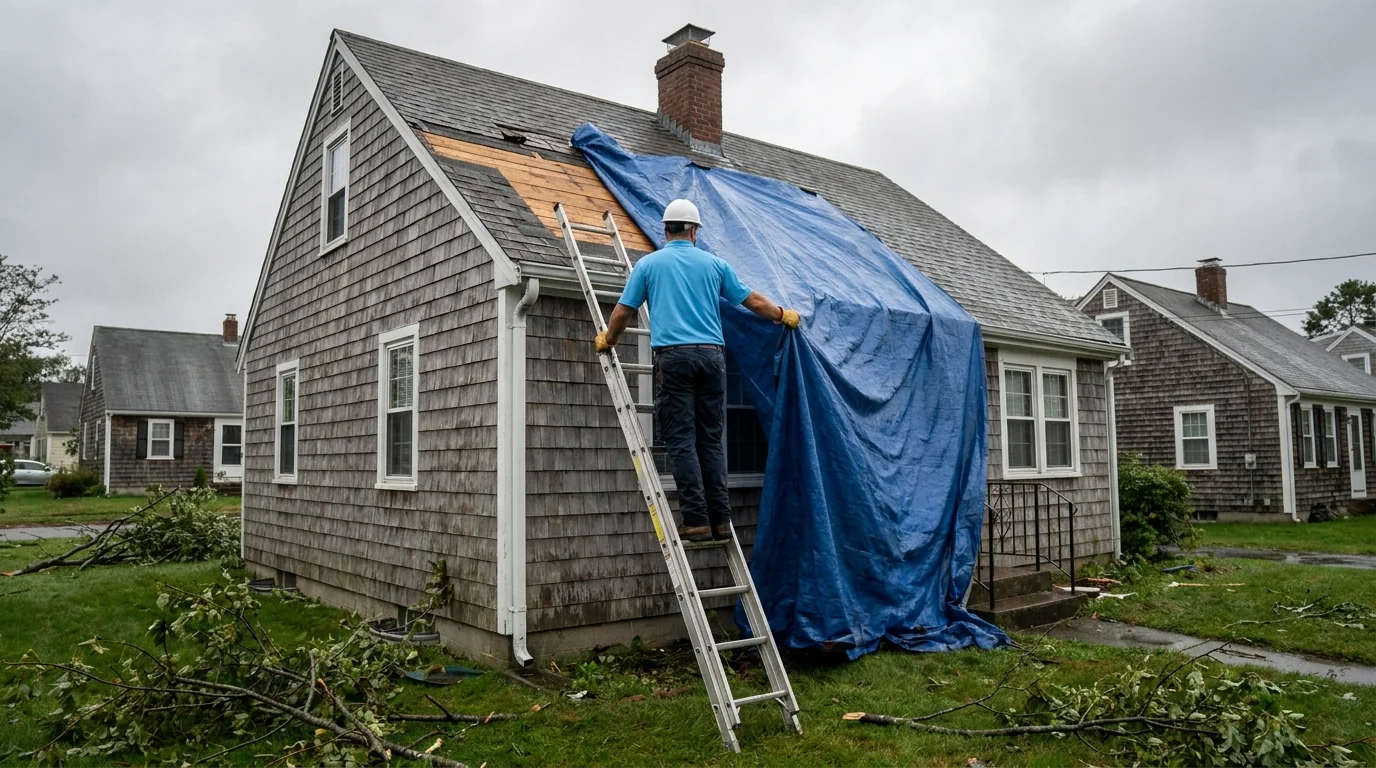
The first visit is about stopping the loss, not just documenting it. That means temporary roof tarping or board-up on storm-damaged openings, extraction from flooded cellars or garage levels, and a moisture map of everything the water touched. In rowhouses near Journal Square, that often means pulling baseboard and checking whether water tracked behind plaster lath, since plaster reads dry at the surface long after the lath behind it is still holding moisture. In waterfront buildings, it means documenting which units and common areas were affected floor by floor, because condo and co-op insurers expect a unit-by-unit record before they’ll release funds to the association.
Once the water is out, drying equipment goes in: air movers, dehumidifiers sized to the affected square footage, and monitoring that continues until materials hit a dry standard, not just until they look dry. For properties where wind or a falling limb opened the building envelope, that drying work runs alongside tarping and board-up so the space stays protected from the next round of weather while the rest of the loss gets handled.
Jersey City Insurance & HOA Coordination
Most storm claims here fall into one of two buckets: a single-family or rowhouse claim filed directly by the owner, or a multi-unit claim that runs through a condo association’s master policy with individual unit owners filing supplemental claims for contents and interior finishes. We photograph and log damage at both levels, which matters in Newport and Exchange Place buildings where the association’s adjuster and a unit owner’s adjuster may ask for different documentation. For Heights and Greenville rowhouses, we itemize storm versus pre-existing conditions clearly, since insurers scrutinize sewer-backup and flood exclusions closely in a city with Jersey City’s flood history.
Local note
In Bergen-Lafayette and Greenville, cellar access is often a narrow exterior hatch rather than an interior stairway, which changes how we stage extraction equipment and how fast we can get pumps running during a heavy storm. We check hatch access and clearance before the crew arrives whenever the address allows it, so the truck isn’t idling on a flooded street while someone finds the right key.
If a storm has already moved through Jersey City and you’re looking at a tarped roof, a flooded cellar, or water tracking down through a waterfront unit, call The Restoration Group now. We’re licensed in New Jersey, IICRC certified, and available around the clock to get your property stabilized and your claim moving.
Serving Jersey City from our Fair Lawn headquarters — ★ 4.8 · 171 Google reviews
“The company was very prepared and professional. They were prompt with coming out to inspect the water damage that occurred and had the team come out the next day. They even wore booties in the house. They cut out all areas of damage, sprayed and use numerous fans and humidifiers in the wet area. I…” - Melanie, October 2026Read our reviews on Google →
Storm Damage Restoration in Jersey City: Service Coverage
Frequently Asked Questions
How fast can you arrive for storm damage restoration in Jersey City?
How fast can you get a crew to a flooded cellar in Greenville or Bergen-Lafayette during a storm?
Does Jersey City's combined sewer system affect how you handle storm cleanup?
How do you coordinate storm damage documentation for condo buildings near Newport and Exchange Place?
What's different about drying storm-damaged rowhouses in the Heights compared to newer construction?
Will you tarp a storm-damaged roof in the 07305 or 07304 area the same day?
Will my homeowners insurance cover storm damage restoration in Jersey City?
Storm Damage Restoration response in Jersey City
Most Jersey City calls see a technician on-site within 60 minutes from our Fair Lawn headquarters.
Nearby & Related
- 24/7 Emergency Storm Damage Restoration in Kenilworth
- Restoration Services in Jersey City
- 24/7 Emergency Fire Damage Restoration in Jersey City
- Mold Remediation in Jersey City
- 24/7 Emergency Storm Damage Restoration in Brooklyn
- 24/7 Emergency Storm Damage Restoration in Cranford
- Contact The Restoration Group