Odor Removal and Deodorization in Hackensack
24/7 odor removal and deodorization in Hackensack, NJ. IICRC-certified, insurance billing accepted. Call (855) 650-7422.
Our IICRC-certified technicians are dispatched from our Fair Lawn, NJ headquarters and are typically on-site in Hackensack within 60 minutes of your call.
Hackensack’s older housing stock holds odors in ways that catch homeowners off guard. The prewar two- and three-family homes throughout Fairmount and the Southside were built with plaster walls, original hardwood subfloors, and minimal vapor barriers, materials that absorb smoke, sewer gas, and flood-driven mildew deeply and release them slowly for months after the visible damage is gone. When a basement floods during a storm surge off the Hackensack River, or a kitchen fire chars the cabinets in a Prospect Avenue high-rise, the smell that lingers is the part most restoration companies underestimate. We don’t.
Why Hackensack Properties Develop Persistent Odor Problems
The same building characteristics that give Hackensack’s neighborhoods their character create ideal conditions for embedded odors. Plaster-and-lath construction, common in homes built before 1955 across the Southside and the Heights, is porous in a way that modern drywall simply isn’t. Smoke particles, mold spores, and sewer gases penetrate past the surface coat and settle into the substrate. Standard surface cleaning or a few cans of spray deodorizer won’t reach them.
Flood events compound the problem. The low-lying areas near the Hackensack River flood regularly in heavy rain, and Tropical Storm Ida in 2021 pushed water into hundreds of Bergen County basements. When standing water sits on concrete or under flooring for even 24 to 48 hours, microbial activity begins, and the musty, organic odor that follows is a byproduct of active bacterial and fungal growth, not just moisture. Removing the water stops the damage; deodorization addresses what the water left behind.
In Hackensack’s stacked apartment buildings along the Prospect Avenue corridor, a single plumbing failure can cascade across three or four units. Aging cast-iron drain lines and galvanized supply pipes fail without warning, and when they do, the resulting sewage or gray-water contamination carries odors that travel through shared wall cavities and HVAC returns. Identifying and treating every affected surface, not just the unit of origin, is what separates a complete job from one that generates a callback.
Our Odor Removal and Deodorization Process in Hackensack
Every job starts with an odor source assessment. We locate the origin, charred framing, saturated insulation, a contaminated drain line, before selecting a treatment method. Masking an odor without addressing its source is a short-term fix that fails within weeks.
Depending on what we find, we deploy one or more of the following methods:
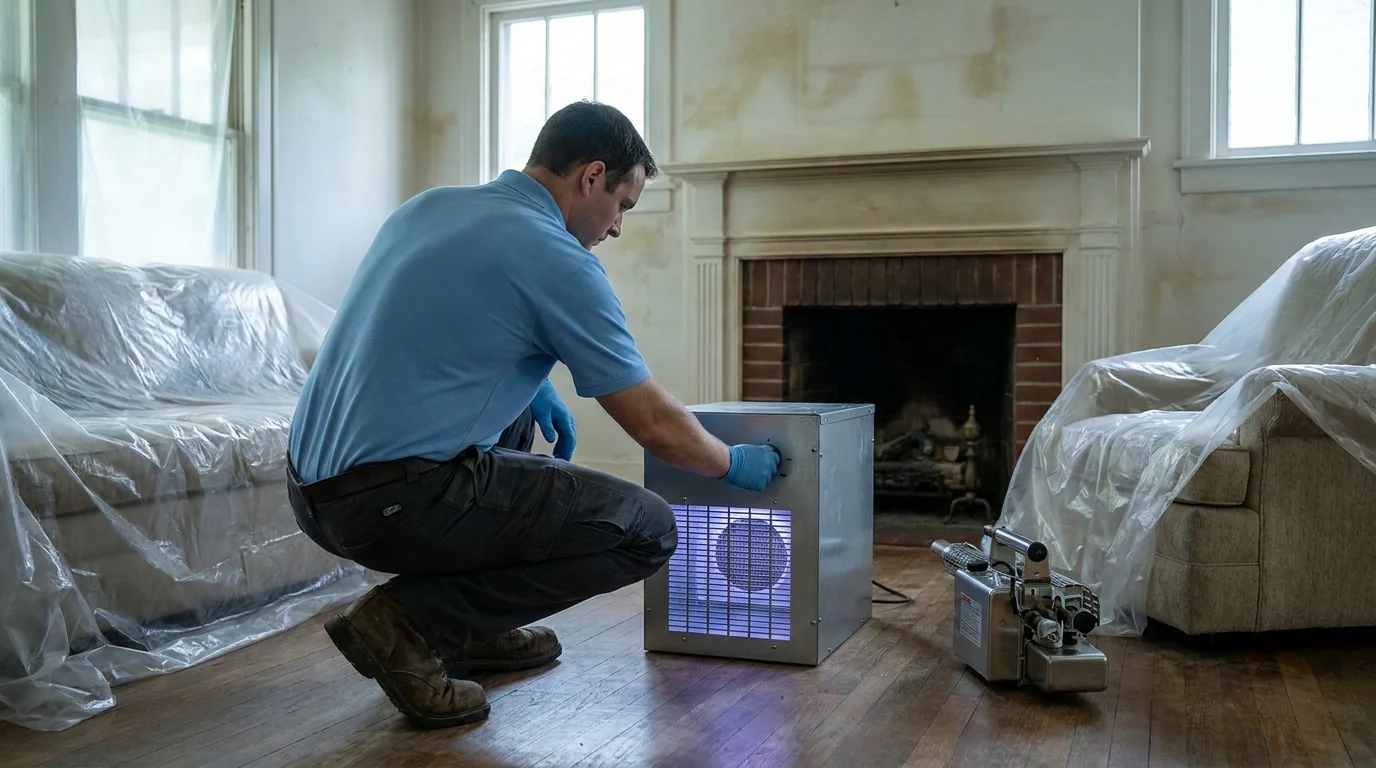
- Thermal fogging, a heated solvent-based fog that penetrates porous surfaces and bonds with odor-causing molecules at the molecular level. Particularly effective in smoke-damaged rooms where soot has embedded in plaster or wood trim.
- Hydroxyl deodorization, UV-generated hydroxyl radicals that break down odor compounds in the air and on surfaces. Safe to run in occupied or partially occupied buildings, which matters in multi-unit properties near the Bergen County Courthouse district where tenants can’t always vacate.
- Ozone treatment, high-concentration ozone that oxidizes odor molecules in sealed, unoccupied spaces. We use this in vacant units or after-hours in commercial spaces along the Main Street business district where foot traffic is cleared.
- HEPA air scrubbing and negative air pressure, removes particulates and prevents cross-contamination to unaffected areas during the process.
After treatment, we conduct clearance testing to confirm odor levels have returned to baseline. We document every step for insurance carriers and property managers.
Equipment Calibrated for Hackensack’s Building Conditions
Older construction requires equipment that can penetrate rather than just surface-treat. In homes with original plaster walls and tongue-and-groove subfloors, a common profile in 07601 ZIP code addresses built between 1920 and 1950, thermal fogging and extended hydroxyl cycles outperform surface-spray methods by a significant margin. We adjust dwell times and machine placement based on room volume, wall composition, and the odor source type.
For high-rise and multi-unit work, containment matters as much as treatment. We use negative air machines to prevent treated air from migrating into adjacent units, and we seal HVAC returns during ozone cycles to protect neighboring spaces.
Reaching Hackensack from Kenilworth
Our team operates 24/7 and dispatches from Kenilworth, NJ. Hackensack is a direct run up Route 9 and the Garden State Parkway, under normal conditions, we’re on-site in under an hour. For commercial losses in the Main Street corridor or medical-adjacent properties near Hackensack University Medical Center, we coordinate access and parking in advance to avoid delays on arrival.
Local Note
In Hackensack’s prewar multi-family homes, particularly the three-family buildings common in Fairmount, original interior walls often contain horsehair plaster over wood lath. This material holds smoke and mold odors differently than modern drywall, the lath creates air pockets behind the plaster face that trap odor compounds and release them slowly over weeks. When we encounter this construction type, we extend hydroxyl treatment cycles and, where necessary, inject deodorizing agents into wall cavities rather than relying solely on surface or airborne treatment. Skipping this step is the most common reason odor jobs in older Hackensack homes get called back.
If you’re dealing with a smoke smell that won’t quit, a basement that still smells like the flood months later, or a unit in a Prospect Avenue building where the odor source is somewhere in the walls, call The Restoration Group at (855) 650-7422. We’re IICRC Certified (Firm #210213), licensed through the NJ Division of Consumer Affairs, and available around the clock.
Serving Hackensack from our Fair Lawn headquarters — ★ 4.8 · 160 Google reviews
“Prompt and professional work. Kept in contact thru out the process which was very important to me.” — F., July 2026Read our reviews on Google →
Odor Removal and Deodorization in Hackensack: Service Coverage
Frequently Asked Questions
How fast can you arrive for odor removal and deodorization in Hackensack?
Why does my Hackensack basement still smell musty months after the water was removed?
Can you treat odors in a Prospect Avenue high-rise without requiring all tenants to vacate?
How does Hackensack's older plaster-and-lath construction affect smoke odor removal?
Does a sewer backup in a Hackensack home require different deodorization than smoke damage?
Will my homeowner's insurance cover professional odor removal for a fire or flood loss in the 07601 area?
Odor Removal and Deodorization response in Hackensack
Most Hackensack calls see a technician on-site within 60 minutes from our Fair Lawn headquarters.