Mold Remediation in Hackensack
24/7 mold remediation in Hackensack, NJ. IICRC-certified, insurance billing accepted. Call (855) 650-7422.
Our IICRC-certified technicians are dispatched from our Fair Lawn, NJ headquarters and are typically on-site in Hackensack within 60 minutes of your call.
Hackensack’s mix of prewar two- and three-family homes, aging cast-iron drains, and the low-lying tidal flats along the Hackensack River creates conditions where mold doesn’t just appear, it spreads fast and quietly. After Hurricane Ida soaked Bergen County basements in 2021, many properties in the 07601 ZIP code sat with residual moisture long enough for mold colonies to establish behind drywall and under subfloors before owners even noticed the smell. When that happens, surface cleaning isn’t enough. Proper mold remediation means containing the affected area, removing compromised materials, and verifying the air is clear before the space is reoccupied.
Why Hackensack Properties See Mold Issues
The housing stock tells most of the story. Older two- and three-family homes throughout the Southside and Fairmount neighborhoods were built when vapor barriers weren’t standard, crawl spaces were common, and galvanized supply lines were the norm. Those galvanized pipes corrode from the inside out, a slow pinhole leak inside a wall cavity can feed mold growth for months before water stains appear on a ceiling. In the high-rise apartment buildings along the Prospect Avenue corridor, a single burst pipe on an upper floor can cascade water through stacked units, leaving multiple tenants dealing with wet walls and ceilings simultaneously.
The geography adds pressure. The eastern edge of the city borders tidal-influenced lowlands where heavy rain events push groundwater up through foundation cracks. Basements in blocks near Johnson Park and lower-elevation streets flood not just from above but from below, leaving concrete block foundations saturated. Block foundations wick moisture into framing and insulation long after the visible water is gone, and that sustained dampness is exactly what mold needs.
Our Mold Remediation Process in Hackensack
Every job starts with a thorough inspection, including moisture mapping with thermal imaging to find wet pockets that aren’t visible to the eye. In Hackensack’s older homes, that often means checking inside plaster walls, beneath original hardwood floors, and around cast-iron drain stacks where condensation accumulates.
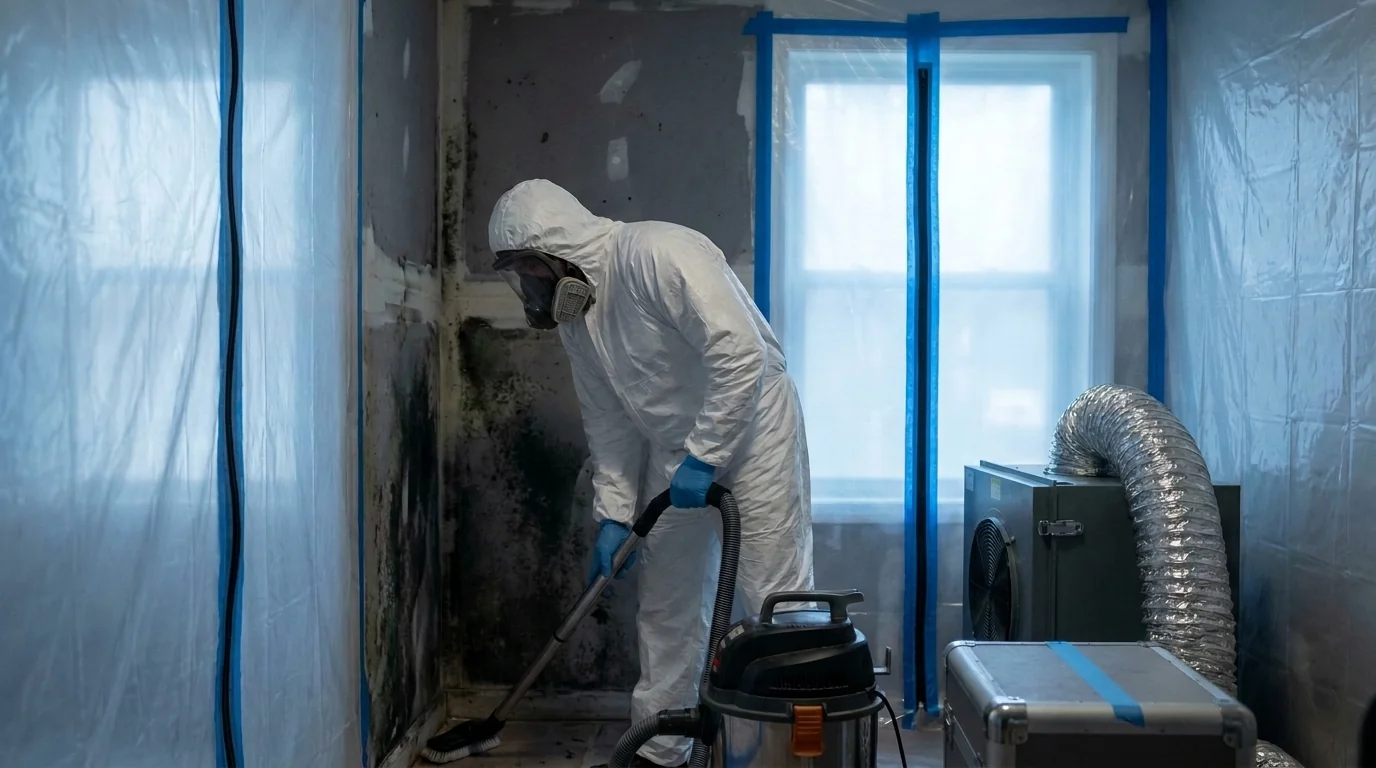
Once affected areas are identified, we establish negative-air containment, plastic sheeting, sealed doorways, and HEPA-filtered air scrubbers running under negative pressure so mold spores can’t migrate to clean rooms during removal. Compromised drywall, insulation, and wood framing are removed and bagged on-site per EPA guidelines. Surfaces are treated with an EPA-registered antimicrobial agent, and we run HEPA air scrubbers through a full air-exchange cycle before clearance testing. As an IICRC Certified Firm (#210213), our process follows the IICRC S520 standard for mold remediation, the same standard that most insurance carriers and industrial hygienists reference when evaluating a completed job.
Reaching Hackensack from Kenilworth
The Restoration Group is based in Kenilworth, NJ, and Hackensack is a regular part of our Bergen County service area. We answer calls 24/7, so whether a property manager at a Main Street commercial building discovers a mold problem at 7 a.m. before tenants arrive, or a homeowner in the Heights notices a musty odor on a Sunday evening, we can schedule and mobilize quickly. Route 3 and I-95 connect Kenilworth to Bergen County efficiently, and our crews are familiar with Hackensack’s street grid, including the parking and access constraints around the Bergen County Courthouse district and the denser residential blocks near Hackensack University Medical Center.
Hackensack Insurance Coordination
Mold claims in Hackensack often trace back to a covered water loss, a burst pipe, an appliance failure, or storm-driven flooding, which means your homeowner’s or commercial property policy may cover a significant portion of the work. We document the loss thoroughly: moisture readings, photographs of affected materials, and a written scope of work formatted for adjuster review. We work directly with most major carriers and can communicate with your adjuster on your behalf to reduce the back-and-forth. For multi-unit properties, where a single loss affects multiple tenants or unit owners, we can coordinate documentation across all affected spaces to support a consolidated claim.
Local Note
In Hackensack’s prewar two- and three-family homes, particularly the wood-frame buildings common through the Southside, original horsehair plaster over wood lath is still intact in many units. Plaster holds moisture differently than modern drywall: it doesn’t crumble and discolor as quickly, so mold can colonize the back side of a plaster wall for an extended period before any visible sign appears on the painted surface. When we’re working in these buildings, we probe carefully before assuming a wall is dry, and we account for longer drying times after water intrusion events. Cutting into original plaster also triggers lead paint protocols under NJ regulations, so our crews are prepared to work under those requirements when the building age warrants it.
If you’re dealing with a mold problem in Hackensack, whether it’s a damp basement in a Fairmount two-family, a flooded unit in a Prospect Avenue high-rise, or a commercial space off Main Street, call The Restoration Group at (855) 650-7422. We’ll assess the situation, explain what remediation actually involves for your specific property, and get the work done to a standard your insurance carrier and future occupants can rely on.
Serving Hackensack from our Fair Lawn headquarters — ★ 4.8 · 160 Google reviews
“Prompt and professional work. Kept in contact thru out the process which was very important to me.” — F., July 2026Read our reviews on Google →
Mold Remediation in Hackensack: Service Coverage
Frequently Asked Questions
How fast can you arrive for mold remediation in Hackensack?
Are homes in Hackensack's Southside and Fairmount neighborhoods at higher risk for mold after a pipe leak?
My Prospect Avenue high-rise had a pipe burst on the floor above me — do I need mold remediation even if my unit looks dry?
Does the tidal flooding that affects low-lying areas near the Hackensack River create a different kind of mold problem than a standard pipe leak?
How does mold remediation work in a Hackensack multi-unit building where several floors were affected by the same water loss?
What does mold remediation actually involve — is it just spraying and wiping surfaces?
Will my homeowners insurance cover mold remediation in Hackensack?
Mold Remediation response in Hackensack
Most Hackensack calls see a technician on-site within 60 minutes from our Fair Lawn headquarters.