Mold Remediation in Plainfield
24/7 mold remediation in Plainfield, NJ. IICRC-certified, insurance billing accepted. Call (844) 808-8838.
Our IICRC-certified technicians are dispatched from our Fair Lawn, NJ headquarters and are typically on-site in Plainfield within 60 minutes of your call.
Basements near the Cedar Brook and Green Brook corridors rarely dry out on their own, and in Plainfield that matters more than most places. Mold Remediation here often starts with a call from a homeowner who noticed a musty smell weeks after a storm, not during one, because the drywall and subfloor stayed damp long after the water receded. If you’re dealing with a musty basement, water-stained ceiling, or visible growth along a baseboard, the timeline for colonization is already working against you.
Why Plainfield Properties See Mold Issues
Plainfield’s low-lying areas along East Front Street and the brook-adjacent blocks took on serious water during Ida in 2021, and that kind of saturation leaves a long tail. Finished basements, common throughout the city’s postwar housing stock, trap humidity against insulation and framing long after the visible flooding is gone. Add in the Victorian and Queen Anne homes around the Van Wyck Brooks Historic District and Sleepy Hollow, many still running original plumbing or knob-and-tube-era wiring behind plaster walls, and you get a building envelope that holds moisture differently than a modern stick-built house. Plaster absorbs slowly and releases slowly, so a leak that looks dry at the surface can still be feeding mold inside the wall cavity weeks later. Cast-iron drain lines common to these older homes are also prone to hairline failures that leak quietly into framing for months before anyone notices a stain.
Our Mold Remediation Process in Plainfield
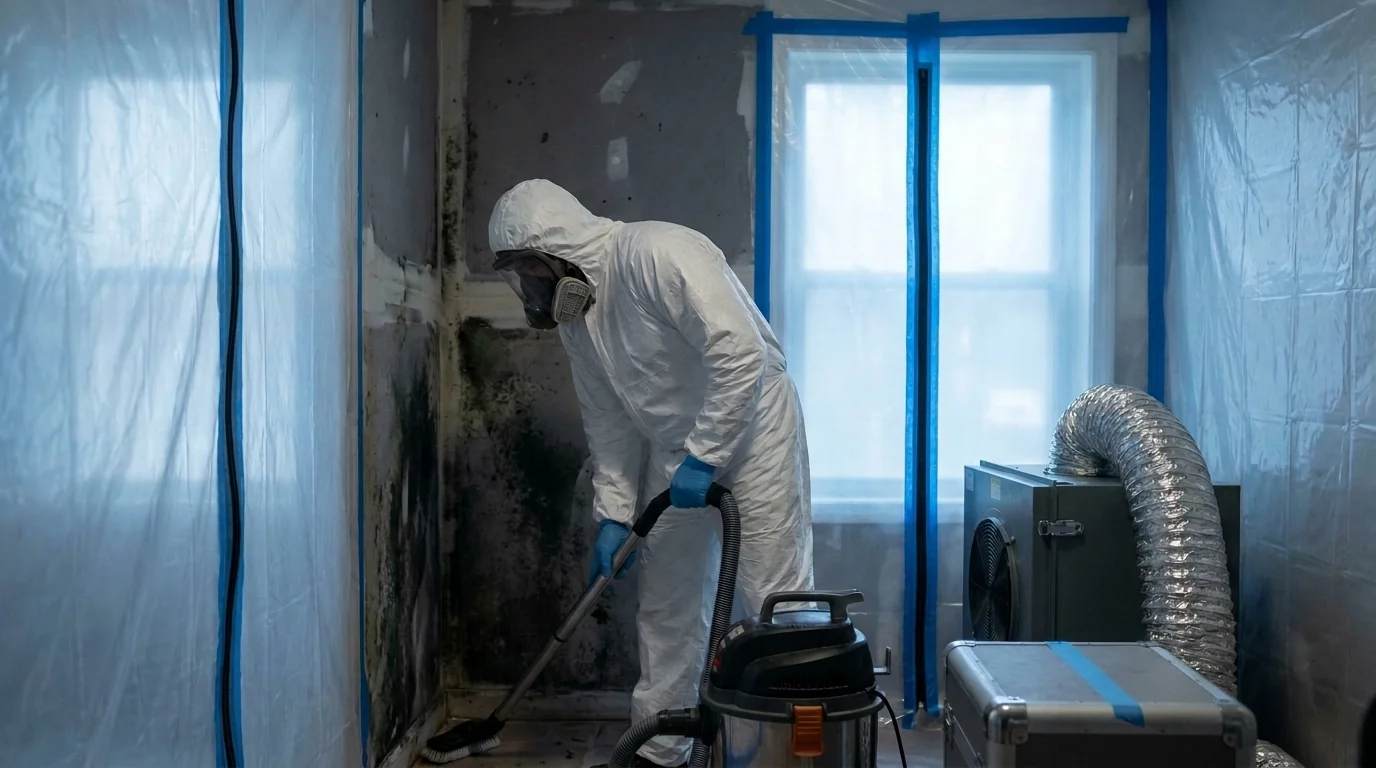
We start with containment, sealing off the affected area with poly sheeting and negative air pressure so spores don’t migrate into the rest of the house while we work, a step that matters more in the tighter floor plans of Netherwood and West End’s early-1900s homes than it would in newer construction. From there, our technicians remove and bag contaminated material, HEPA-vacuum surrounding surfaces, and run air scrubbers while drying is monitored against the IICRC S500 and S520 standards. In homes with plaster or horsehair lath, we test moisture content before deciding how much material actually needs to come out, since over-demoing a historic wall assembly creates problems a modern drywall job wouldn’t. Once the space reads dry and clearance testing (when ordered by the homeowner or carrier) comes back clean, we hand the space back ready for whoever handles the cosmetic repairs.
Plainfield Insurance & HOA Coordination
Most of the mold claims we see in Plainfield trace back to a covered water event, a burst supply line, a failed sump, storm intrusion, rather than long-term neglect, and that distinction matters for how a carrier treats the claim. We document moisture readings, photograph affected materials before removal, and provide the kind of paper trail adjusters expect to see before approving remediation costs. For properties inside the Van Wyck Brooks Historic District, we’re mindful that exterior and sometimes interior material changes can fall under local preservation review, so we coordinate scope with homeowners before cutting into anything that might need sign-off later. We don’t handle the rebuild side of a project ourselves, but we make sure our scope and documentation line up cleanly with whoever does.
Local note
Homes within a few blocks of the Cedar Brook, particularly in the Crescent Area and the lower parts of Netherwood, tend to hold ambient humidity well above normal even on dry weeks, which means mold can return behind baseboards or inside closets months after a remediation if the underlying moisture source wasn’t fully addressed. We’ve found it worth checking crawl spaces and sump discharge lines on these properties even when the visible problem is confined to one room, since a slow-draining yard can keep feeding moisture into the foundation long after the storm that started it.
If you’re smelling something musty in a Plainfield basement or seeing discoloration spread along a wall near East Front Street, Netherwood, or anywhere in between, it’s worth having it looked at before the next humid stretch makes it worse. Call The Restoration Group at (844) 808-8838 and we’ll get a technician out to assess the source, not just the symptom.
Serving Plainfield from our Fair Lawn headquarters — ★ 4.8 · 171 Google reviews
“I had a very positive experience working with The Restoration Group. From the beginning, their team was professional, responsive, courteous, and attentive to my concerns. They took the time to explain the restoration process, answer my questions, and make sure I understood each step along the way…” - Cindy, November 2026Read our reviews on Google →
Mold Remediation in Plainfield: Service Coverage
Frequently Asked Questions
How fast can you arrive for mold remediation in Plainfield?
Are homes near the Cedar Brook and Green Brook more likely to develop mold after storms?
Does the Van Wyck Brooks Historic District have rules that affect mold remediation work?
How is mold remediation different in Plainfield's older plaster-walled homes compared to newer construction?
What equipment do you use for containment and air quality during a job?
Will my insurance cover mold remediation if it started from a burst pipe in my Plainfield home?
Mold Remediation response in Plainfield
Most Plainfield calls see a technician on-site within 60 minutes from our Fair Lawn headquarters.