Odor Removal and Deodorization in Maplewood
24/7 odor removal and deodorization in Maplewood, NJ. IICRC-certified, insurance billing accepted. Call (855) 650-7422.
Our IICRC-certified technicians are dispatched from our Fair Lawn, NJ headquarters and are typically on-site in Maplewood within 60 minutes of your call.
The 1920s Tudor on your block in Maplewood’s Hilton neighborhood has thick original plaster walls, a stone foundation, and decades of layered paint, and when smoke, sewer gas, or flood water works its way into that structure, the odor doesn’t leave on its own. It absorbs into the plaster, settles into the subfloor, and recirculates every time the heat kicks on. The Restoration Group provides professional odor removal and deodorization in Maplewood (07040), using equipment and methods matched to the specific building stock and loss patterns common in this town.
Why Maplewood Properties Hold Odors Longer
Maplewood’s housing stock, predominantly Tudors, colonials, and craftsman bungalows built between roughly 1910 and 1940, creates odor challenges that newer construction simply doesn’t. Original plaster walls are porous in a way that modern drywall is not. Smoke particles, mold volatile organic compounds (VOCs), and sewer gases penetrate deeply into the substrate and bind there. Surface cleaning or a few open windows won’t reach them.
Flood losses compound the problem. The East Branch of the Rahway River runs through Memorial Park and directly through Maplewood Village, and it has a documented history of overtopping during major storms, the flooding from Ida in 2021 left standing water in finished basements and street-level commercial spaces across the village and surrounding low-lying streets for days. Water that sits in a finished basement for 48 to 72 hours begins supporting microbial growth, and that biological activity produces the musty, earthy odor that persists long after the water is extracted. Older cast-iron drain lines in these homes are also prone to partial blockages and slow seepage that introduce sewage odors into crawl spaces and utility areas without an obvious visible source.
Our Odor Removal and Deodorization Process in Maplewood
Effective deodorization isn’t a single step, it’s a sequence calibrated to the source, the affected materials, and the structure itself.
Source removal first. No deodorization technology eliminates an odor that is still actively generating. We locate and remove or treat the source material, charred framing, saturated insulation, contaminated subfloor, before any chemical or equipment treatment begins.
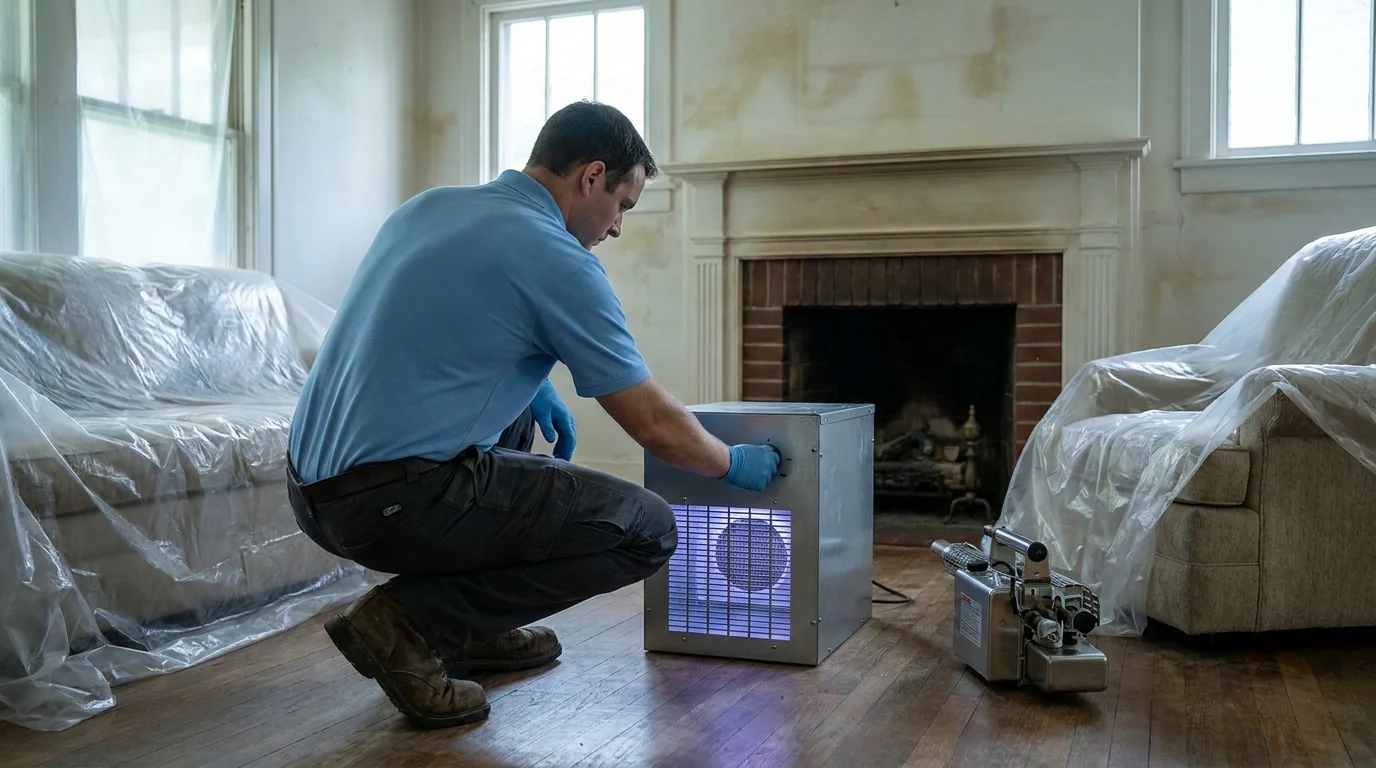
Thermal fogging penetrates the same pathways smoke traveled. A petroleum-based or water-based deodorizing fog is heated and introduced into the space; the fine particles follow smoke residue into wall cavities, HVAC ducts, and behind original trim work, the exact places a spray-and-wipe approach misses in these older homes.
Hydroxyl deodorization is our preferred ongoing treatment for occupied or partially occupied spaces. Hydroxyl generators produce hydroxyl radicals that break down odor-causing molecules at a chemical level without requiring occupants to vacate. For severe smoke odor removal or post-flood biological odors, we may use ozone treatment in unoccupied spaces, which is highly effective but requires a complete evacuation of people, pets, and plants during the treatment window.
HVAC and ductwork treatment is a step that gets skipped in a lot of odor jobs, and it’s the reason odors return. In Maplewood’s older homes, original duct runs often pass through unconditioned spaces and collect years of particulate. We treat accessible duct surfaces and supply registers as part of the deodorization scope.
Equipment & Methods We Use for Odor Removal
The right tool depends on the odor source and the affected materials:
- Ozone generators, highly effective for smoke odor removal in vacant structures; breaks down VOCs at the molecular level
- Hydroxyl generators, safe for occupied spaces; slower than ozone but appropriate when full evacuation isn’t practical
- Thermal foggers, penetrate porous surfaces including original plaster and wood framing
- Air scrubbers with activated carbon filtration, capture airborne odor molecules and particulates during and after treatment
- Moisture meters and thermal imaging, identify hidden wet material that is the actual odor source before treatment begins
As an IICRC Certified Firm (#210213), our process follows the S520 and applied structural drying standards that govern professional odor elimination, not a proprietary checklist.
Reaching Maplewood from Kenilworth
Our team operates 24/7 out of Kenilworth, NJ, and Maplewood is a straightforward run, typically via Route 22 East to Springfield Avenue or Garden State Parkway to Route 78 West depending on traffic. We serve the full township, including the Maplewood Village shopping district, the train-station corridor, the Jefferson and Tuscan neighborhoods, and residential streets throughout The Fields. When you call (855) 650-7422, dispatch confirms your address and routes the closest available crew.
Local Note
One pattern we see repeatedly in Maplewood’s pre-war homes: finished basements with original wood-panel or tongue-and-groove walls. After a flood event, the kind the Rahway River corridor sees during a nor’easter or a tropical remnant, those panels absorb water along the bottom two feet and begin off-gassing a musty odor within days. Homeowners often treat the visible surface and assume the job is done. The actual odor source is usually the backside of the panel and the framing cavity behind it, which never fully dried. Thermal imaging and moisture readings on both faces of the wall are the only way to confirm whether the material needs to come out or can be dried in place, and skipping that step is why odor jobs in these houses sometimes have to be redone.
If your home in Maplewood is holding an odor that cleaning hasn’t resolved, smoke from a kitchen fire, must from a wet basement, or a sewer smell with no obvious source, call The Restoration Group at (855) 650-7422. We assess the source, explain the treatment options, and give you a clear scope before any work begins.
Serving Maplewood from our Fair Lawn headquarters — ★ 4.8 · 160 Google reviews
“Prompt and professional work. Kept in contact thru out the process which was very important to me.” — F., July 2026Read our reviews on Google →
Odor Removal and Deodorization in Maplewood: Service Coverage
Frequently Asked Questions
How fast can you arrive for odor removal and deodorization in Maplewood?
How quickly can The Restoration Group reach a Maplewood address for an odor emergency?
Maplewood's older Tudor and colonial homes have original plaster walls — does that change how odor removal is done?
Our finished basement flooded during a storm — the water is gone but the musty smell remains. Is that common in Maplewood?
What is the difference between ozone treatment and hydroxyl deodorization, and which one is used in Maplewood homes?
Will my homeowner's insurance cover professional odor removal after a fire or flood in Maplewood?
Odor Removal and Deodorization response in Maplewood
Most Maplewood calls see a technician on-site within 60 minutes from our Fair Lawn headquarters.