
24/7 Emergency Water Damage Restoration in Jersey City
24/7 emergency water damage restoration in Jersey City, NJ. IICRC-certified, insurance billing accepted. Call (844) 808-8838.
Our IICRC-certified technicians are dispatched from our Fair Lawn, NJ headquarters and are typically on-site in Jersey City within 60 minutes of your call.
Water damage in Jersey City doesn’t wait for business hours, and neither do we. Whether a supply line lets go in a Newport high-rise or a cellar in Bergen-Lafayette takes on water during a hard rain, the clock starts the moment water hits a floor. We answer 24/7 and bring IICRC-trained crews and extraction equipment to stop the spread before drywall, subfloor, and finishes are lost.
Why Jersey City Properties See Water Damage Issues
Jersey City is really two different risk profiles living a few blocks apart. Along the waterfront at Newport and Exchange Place, dense high-rise condos and rentals share risers, supply lines, and mechanical rooms, so one failed fitting on floor 12 can send water through six units below before anyone notices a drip. Inland, in The Heights, Bergen-Lafayette, and Greenville, the housing stock is largely 1890s to 1920s brownstones and frame rowhouses with cellars that sit close to grade. Those cellars tie into a combined sewer system that handles both stormwater and wastewater, and during heavy rain the pipes can back up faster than they drain, pushing water into foundations that were never built with a sump pit in mind. Hurricane Sandy’s surge exposed just how low-lying Jersey City’s eastern blocks really are, and Ida showed the same vulnerability inland, flooding basements across the city that had never taken on water before. Add a water table that sits close to the surface in much of 07304 and 07305, and a lot of foundations here are dealing with hydrostatic pressure even on dry weeks.
Our Water Damage Restoration Process in Jersey City
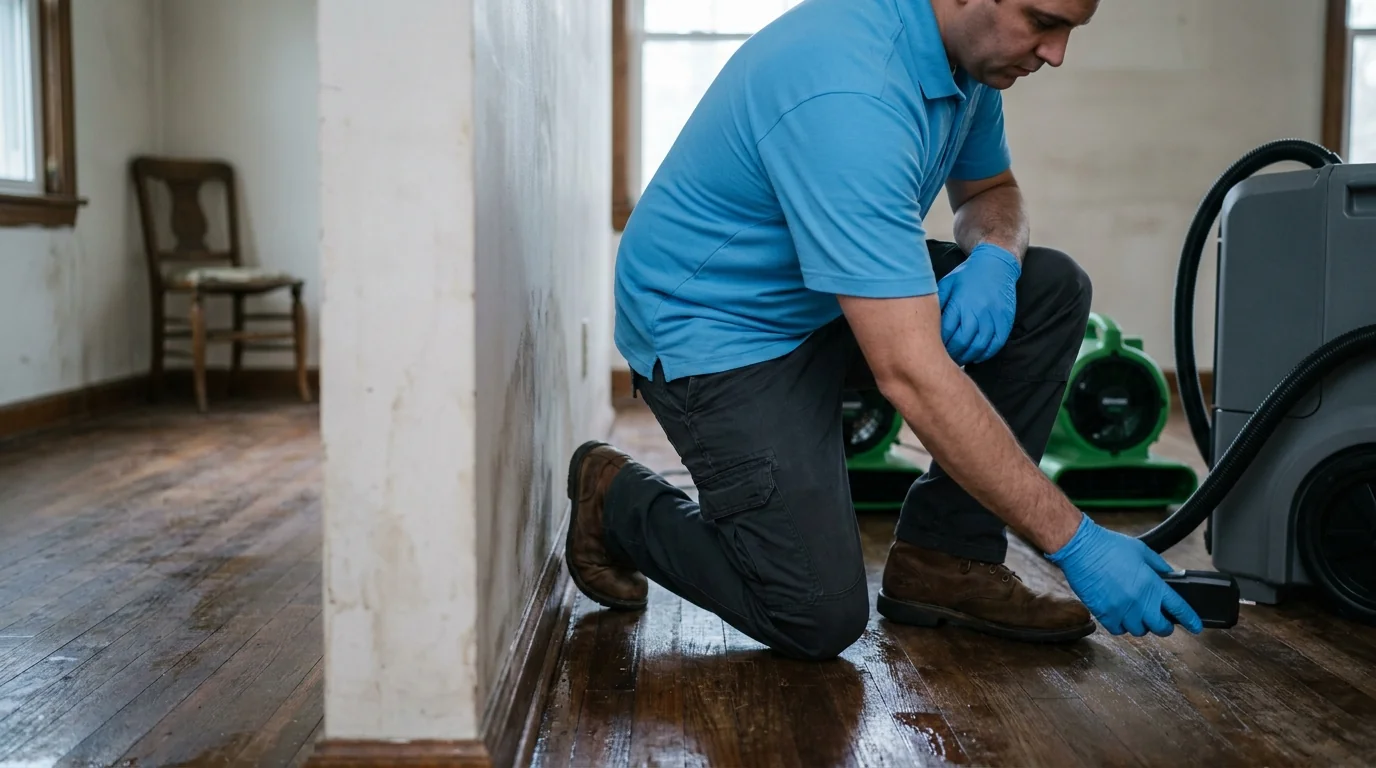
The first visit is about stopping loss, not paperwork. Crews shut off the source where it’s safe to do so, extract standing water with truck-mount and portable units, and pull up flooring or baseboards where water has gotten behind the surface. In brownstones near Journal Square and the Heights, that often means checking plaster walls separately from the drywall in later additions, since plaster holds moisture longer and reads deceptively dry on a surface scan. In Newport and Exchange Place condos, we document moisture readings unit by unit, since a single pipe failure in a stacked building can affect multiple owners and each one may need separate drying logs for their association’s insurer. Once materials are extracted, we set air movers and dehumidifiers calibrated to the room’s actual moisture load, not a flat formula, and we track drying progress daily against the IICRC S500 standard until materials hit a dry standard, not just a dry feel.
Jersey City Insurance & HOA Coordination
Condo and co-op boards in buildings along the Exchange Place waterfront usually require documentation that separates building-owned common elements from unit-owner contents and finishes, since those often fall under different insurance policies. We photograph and log moisture readings room by room so the association’s management company and the unit owner’s carrier each get what they need without a second visit. For landlords with multifamily rowhouses in Greenville or Bergen-Lafayette, we provide the same kind of itemized drying report, which speeds up claims when a tenant’s unit and a shared cellar are both affected. We’re a NJ Licensed Home Improvement Contractor, so the paperwork holds up whether the claim runs through a homeowner’s policy or a commercial landlord policy.
Local note
In the Heights and parts of Bergen-Lafayette, older cellar floor drains tie directly into the combined sewer line with no backflow valve, which means a heavy storm can push wastewater back into the cellar through the drain itself rather than through a window or crack. When we’re called to one of these addresses after a storm, we check that drain first, because treating the water as straight stormwater when it’s actually mixed with sewage changes how we handle extraction, sanitizing, and what materials need to come out versus what can be dried in place.
If your property is taking on water right now, in a high-rise near Grove Street PATH plaza, a rowhouse cellar in Journal Square, or anywhere in between, call The Restoration Group at (844) 808-8838. We’re based in Fair Lawn and cover Jersey City as part of our Union, Bergen, and Essex county service area, and our crews are set up to start water removal and structural drying the same day you call.
Serving Jersey City from our Fair Lawn headquarters — ★ 4.8 · 171 Google reviews
“The company was very prepared and professional. They were prompt with coming out to inspect the water damage that occurred and had the team come out the next day. They even wore booties in the house. They cut out all areas of damage, sprayed and use numerous fans and humidifiers in the wet area. I…” - Melanie, October 2026Read our reviews on Google →
Water Damage Restoration in Jersey City: Service Coverage
Frequently Asked Questions
How fast can you arrive for water damage restoration in Jersey City?
How fast can you get a crew to a flooded unit near Exchange Place or Newport?
Do Jersey City's older cellars need different water extraction than a modern basement?
Will my condo association need separate documentation from my own water damage claim?
How do you dry out plaster walls in older Jersey City homes without over-demoing?
Does flood insurance or a standard homeowner's policy cover basement flooding in Jersey City?
Water Damage Restoration response in Jersey City
Most Jersey City calls see a technician on-site within 60 minutes from our Fair Lawn headquarters.
Nearby & Related
- 24/7 Emergency Water Damage Restoration in Kenilworth
- Restoration Services in Jersey City
- 24/7 Emergency Fire Damage Restoration in Jersey City
- Mold Remediation in Jersey City
- 24/7 Emergency Water Damage Restoration in Brooklyn
- 24/7 Emergency Water Damage Restoration in Cranford
- Contact The Restoration Group