Odor Removal and Deodorization in Hoboken
24/7 odor removal and deodorization in Hoboken, NJ. IICRC-certified, insurance billing accepted. Call (855) 650-7422.
Our IICRC-certified technicians are dispatched from our Fair Lawn, NJ headquarters and are typically on-site in Hoboken within 60 minutes of your call.
Hoboken’s dense grid of 19th-century brownstones and below-grade garden units traps odors in ways that catch even experienced property owners off guard. When Sandy flooded much of the city in 2012 and again when Ida overwhelmed the combined sewer system in 2021, the standing water that backed into basements along the Downtown Hoboken corridor didn’t just cause structural damage, it left behind a persistent sulfuric, sewage-tinged smell embedded in brick, plaster, and original hardwood that generic air fresheners can’t touch. Professional deodorization in a city built this densely, with this much shared wall space and this many below-grade living spaces, requires a calibrated approach.
Why Hoboken Properties Are Especially Prone to Embedded Odors
The same geology that makes Hoboken flood-prone, low-lying former tidal marsh reclaimed from the Hudson, also means moisture never fully leaves the building envelope. Pre-1900 brick and brownstone construction in neighborhoods like Uptown and Southwest Hoboken were built without modern vapor barriers. When a pipe bursts inside a shared party-wall stack (a common event in the aging plumbing that runs through these rowhomes), water and the odors it carries wick laterally into masonry and plaster before a tenant even notices the leak.
Smoke odors present a similar challenge. A kitchen fire or cigarette-saturated unit in a multi-family brownstone doesn’t stay contained, HVAC returns, shared chases, and the natural stack effect in tall narrow buildings pull smoke particulate through the entire structure. The Washington Street business district adds a commercial layer: restaurant grease fires, sprinkler activations, and the kind of long-term cooking odors that saturate drywall over years of continuous use.
The newer waterfront high-rises near Pier A Park face different but equally stubborn odor problems. Mechanical ventilation systems in these buildings can recirculate odor-causing compounds across multiple floors after a single-unit event, and HOA boards in these properties often require documented clearance before a unit can be re-occupied.
Our Deodorization Process, Calibrated for Hoboken Buildings
Odor removal isn’t a single step, it’s a sequence of methods matched to the source and the substrate. The process typically moves through four stages:
Source removal first. No deodorization technology eliminates an odor that still has an active source. We locate and remove all contaminated material, charred framing, saturated insulation, sewage-affected drywall, before any treatment begins. In Hoboken’s older plaster-wall construction, this sometimes means opening walls that look dry on the surface but are holding moisture and odor compounds inside the lath cavity.
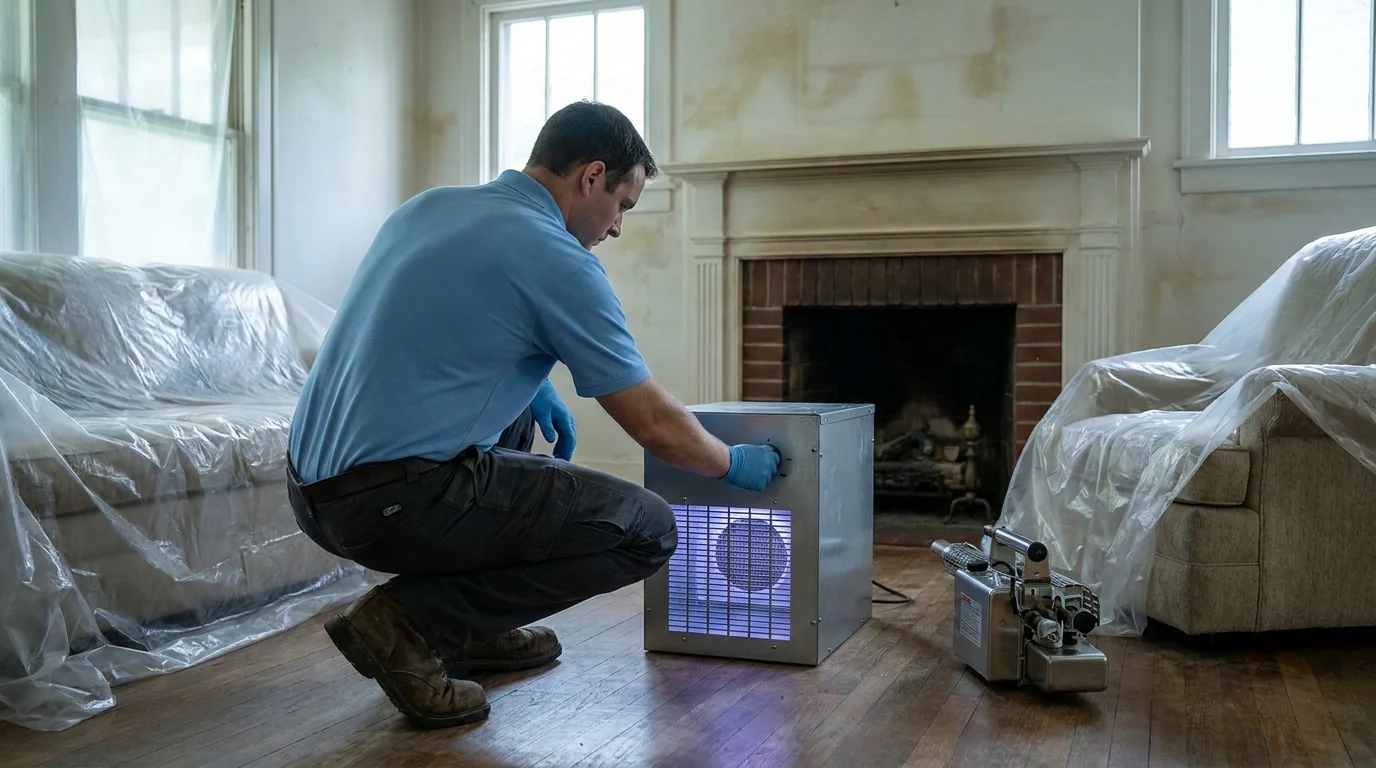
Thermal fogging for penetrating odors. For smoke and fire losses, thermal fogging disperses a deodorizing solvent as a fine fog that follows the same pathways smoke traveled, into wall cavities, subflooring gaps, and HVAC ductwork. This is particularly effective in the narrow floor plans common to Castle Point and Midtown brownstones, where smoke moves vertically through the building quickly.
Hydroxyl or ozone treatment for structural saturation. Hydroxyl generators are safe to run in occupied adjacent units, an important consideration in Hoboken’s attached rowhomes where neighbors share walls. Ozone treatment, which requires full evacuation, is reserved for severe losses where faster oxidation of odor compounds is necessary. We determine which is appropriate based on the building type, the odor source, and whether adjacent units can be safely isolated.
Final air scrubbing and verification. HEPA air scrubbers run through the final phase to capture any remaining airborne particulate. We don’t consider the job complete until a post-treatment walkthrough confirms the odor is gone, not masked.
Equipment & Methods We Use for Odor Removal
The equipment deployed on a Hoboken job is selected for the specific odor source and building construction:
- Hydroxyl generators, broad-spectrum deodorization safe for occupied adjacent spaces; effective for biological and smoke odors in multi-unit buildings
- Thermal foggers, penetrate porous masonry and plaster cavities where smoke or fire odors have migrated beyond surface materials
- Ozone machines, high-concentration oxidation for severe losses; requires full evacuation and careful reentry protocols
- HEPA air scrubbers, continuous air filtration during and after treatment to remove particulate odor carriers
- Moisture meters and thermal imaging, used to confirm no hidden wet material is sustaining the odor source before treatment closes out
All work is performed by an IICRC Certified Firm (#210213), and we carry the licensing required under the NJ Division of Consumer Affairs for home improvement contracting in New Jersey.
Reaching Hoboken from Kenilworth
Our team operates 24/7 and dispatches from Kenilworth, NJ. The most direct route to Hoboken runs via the Garden State Parkway to the New Jersey Turnpike and into Hoboken through the Lincoln Tunnel approach or Route 3 East, a corridor our crews run regularly on both daytime and overnight calls. For addresses in the 07030 ZIP code, we coordinate parking and equipment staging in advance when possible, since street access near Hoboken Terminal and along the Washington Street corridor can be tight, especially during morning commuter hours.
Local Note
In Hoboken’s below-grade garden units, the ones that took the worst flooding during Ida in 2021, the original brick foundation walls often have no interior finish. That exposed masonry absorbs sewage odor compounds deeply, and standard surface-applied deodorizers do almost nothing. What actually works is a combination of enzymatic treatment applied directly to the brick, followed by a hydroxyl generator running for an extended dwell time in the sealed space. We’ve found that units in the Southwest Hoboken blocks closest to the old combined sewer outfalls tend to need longer treatment cycles than comparable units elsewhere in the city, the odor compounds in combined sewer overflow are more complex than a straightforward freshwater loss.
If you’re dealing with a persistent smell in a Hoboken property, whether it’s smoke, sewage, mold, or something you can’t quite identify, call The Restoration Group at (855) 650-7422. We’ll assess the source, explain the treatment plan, and get to work on a schedule that works for your building and your neighbors.
Serving Hoboken from our Fair Lawn headquarters — ★ 4.8 · 160 Google reviews
“Teams were very prompt and respectful.. company responded quickly and kept in touch” — Peggy, August 2026Read our reviews on Google →
Odor Removal and Deodorization in Hoboken: Service Coverage
Frequently Asked Questions
How fast can you arrive for odor removal and deodorization in Hoboken?
How quickly can The Restoration Group reach a Hoboken address for an odor emergency?
Are the below-grade garden units common in Downtown Hoboken and Southwest Hoboken harder to deodorize after a sewer backup?
Can smoke odor from one unit in a Hoboken brownstone spread to neighboring units through shared walls?
What's the difference between ozone treatment and hydroxyl deodorization, and which is right for my Hoboken property?
Will my insurance cover professional odor removal after a covered loss in Hoboken, and does The Restoration Group handle the documentation?
Odor Removal and Deodorization response in Hoboken
Most Hoboken calls see a technician on-site within 60 minutes from our Fair Lawn headquarters.