Mold Inspection and Testing in Hoboken
24/7 mold inspection and testing in Hoboken, NJ. IICRC-certified, insurance billing accepted. Call (855) 650-7422.
Our IICRC-certified technicians are dispatched from our Fair Lawn, NJ headquarters and are typically on-site in Hoboken within 60 minutes of your call.
Hoboken’s position on a former tidal marsh means water has always found a way in, through basement walls after heavy rain, up through floor drains when the combined sewer backs up, and into the party walls shared between century-old brownstones. When moisture lingers in a below-grade garden unit or a poorly ventilated rowhouse, mold can begin colonizing porous surfaces within 24 to 48 hours. A professional mold inspection and testing engagement gives you documented evidence of what’s actually growing, where the moisture source is, and what remediation, if any, is genuinely warranted.
Why Hoboken Properties Are Especially Prone to Mold Growth
Hoboken’s housing stock tells the story. The majority of residential buildings in the 07030 ZIP code were constructed before 1940, when vapor barriers were nonexistent and basement walls were unreinforced brick or rubble stone. Those walls wick groundwater year-round, and the problem compounds in below-grade units that line blocks from Southwest Hoboken up through Uptown. After Superstorm Sandy submerged much of the city in 2012, and again when Ida’s rainfall in 2021 overwhelmed the sewer system and pushed water into thousands of basements, many units dried out visually but retained moisture inside wall cavities and under flooring, conditions that quietly fed mold colonies for months or years afterward.
Shared plumbing stacks in attached rowhouses create a second exposure pathway. A slow leak inside a party wall can saturate the framing on both sides of the property line before either neighbor notices staining. Near the Washington Street business district and around Stevens Institute of Technology, commercial sprinkler systems and aging roof assemblies add institutional-scale water events to the mix. Newer waterfront high-rises along the Hudson bring their own challenges: mechanical rooms, podium parking decks, and HVAC condensate lines that can drip undetected for entire seasons.
Our Mold Inspection and Testing Process in Hoboken
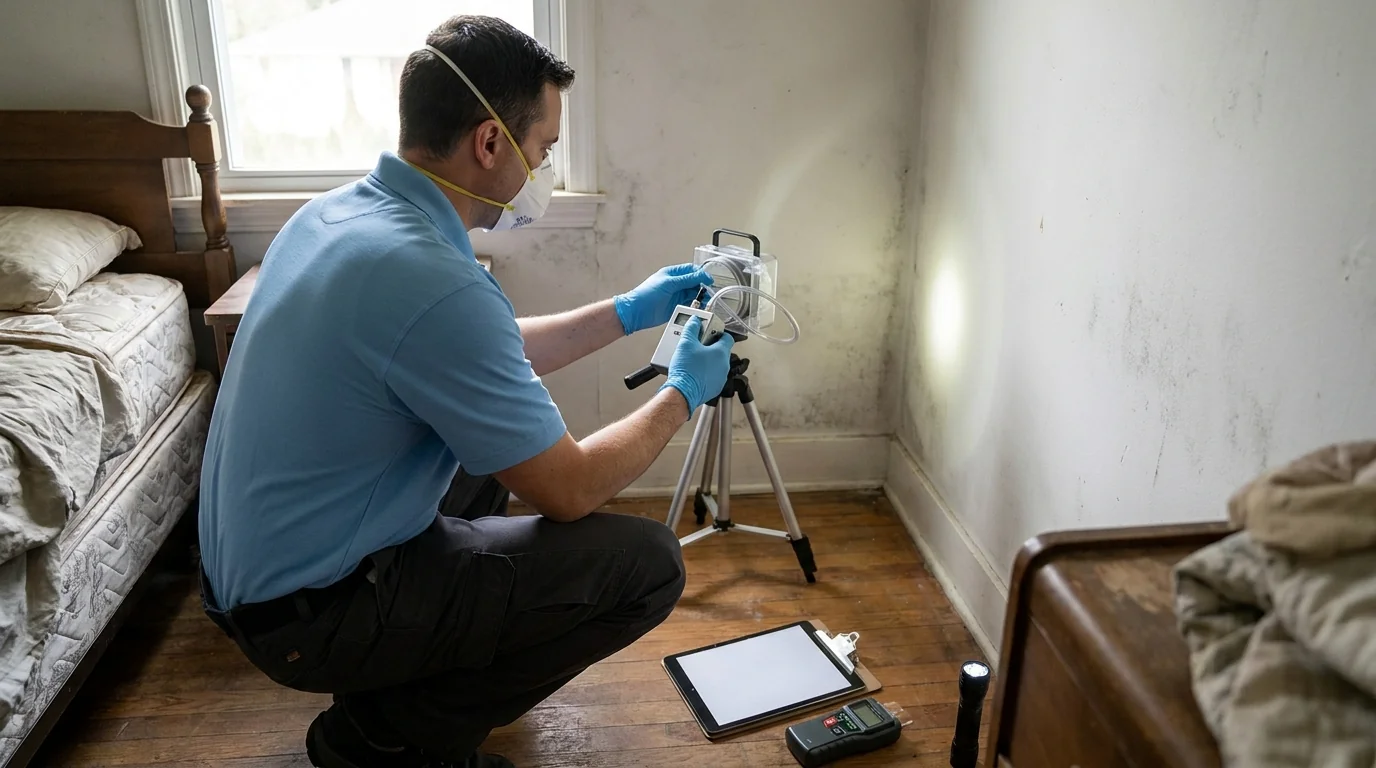
A mold inspection is an investigative process, not a visual walk-through. When we arrive at a Hoboken property, we begin with a moisture mapping survey using calibrated meters and thermal imaging to locate elevated readings behind walls, under flooring, and inside ceiling assemblies, areas where mold grows before it’s ever visible. We document every anomalous reading with photographs and note construction details relevant to the building type: brick cavity walls, original plaster lath, cast-iron drain stacks, and the like.
If sampling is warranted, we collect air samples from affected zones and an unaffected control area, typically a room on an upper floor or an exterior reference, and send them to an accredited third-party laboratory. Depending on findings, we may also collect surface swab or tape-lift samples from visible growth to identify species. Lab results typically return within two to three business days. You receive a written report that includes spore counts by species, a comparison to the control sample, moisture readings, and our assessment of likely source conditions. That report is formatted to be useful to your insurance adjuster, your co-op or condo board, or a prospective buyer’s attorney.
The Restoration Group holds IICRC Certified Firm status (#210213) and is licensed as an NJ Home Improvement Contractor through the NJ Division of Consumer Affairs, credentials that matter when a Hoboken landlord or HOA needs documentation they can stand behind.
Hoboken Insurance and HOA Coordination
Mold claims in Hoboken often involve multiple parties: a tenant, a landlord, a condo association, and sometimes a neighbor whose plumbing was the original source. A clear inspection report with laboratory-backed spore counts and identified moisture intrusion points is the document that moves those claims forward. We photograph affected materials in a format consistent with insurance carrier documentation standards, and we can speak directly with adjusters when the scope of a potential remediation needs to be justified.
For condo and co-op buildings, common throughout Downtown Hoboken and along the Waterfront, boards frequently require independent testing before approving remediation work inside a unit. Our written report satisfies that requirement and gives the board a defensible record if the issue resurfaces.
Local Note: What Sandy and Ida Left Behind
One pattern we see repeatedly in Hoboken inspections: a homeowner or tenant reports a musty smell that appeared gradually, with no obvious recent water event. In many cases, the moisture source traces back to a flood event years earlier, Sandy in 2012, a nor’easter in 2018, or Ida in 2021, where the visible water was removed but the wall assembly never fully dried. Original horsehair plaster on brick, common in pre-war rowhouses from Castle Point to Elysian Park, holds moisture differently than modern drywall. It can test dry at the surface while retaining enough residual humidity inside the assembly to sustain mold growth indefinitely. Thermal imaging during an inspection often reveals the thermal signature of that trapped moisture even when a moisture meter at the surface reads normal, which is why surface-only assessments miss the problem entirely.
If you’re in Hoboken and something smells off, or you’re buying, selling, or managing a property and need documented air quality data, call The Restoration Group at (855) 650-7422. We’re available around the clock, and we’ll give you a clear picture of what’s actually happening inside your building.
Serving Hoboken from our Fair Lawn headquarters — ★ 4.8 · 160 Google reviews
“Teams were very prompt and respectful.. company responded quickly and kept in touch” — Peggy, August 2026Read our reviews on Google →
Mold Inspection and Testing in Hoboken: Service Coverage
Frequently Asked Questions
How fast can you arrive for mold inspection and testing in Hoboken?
How quickly can The Restoration Group reach a Hoboken address for a mold inspection?
Are below-grade garden units in Hoboken's brownstones at higher mold risk than upper-floor apartments?
My Hoboken condo board is requiring an independent mold test before approving remediation — can your report satisfy that requirement?
What does mold air testing actually measure, and how is it different from a visual inspection?
We bought a Hoboken rowhouse and suspect the previous owners had a flood — is a mold inspection worth doing even if we don't see visible growth?
Will my homeowners insurance cover mold inspection and testing in Hoboken?
Mold Inspection and Testing response in Hoboken
Most Hoboken calls see a technician on-site within 60 minutes from our Fair Lawn headquarters.