24/7 Emergency Water Damage Restoration in Fort Lee
24/7 emergency water damage restoration in Fort Lee, NJ. IICRC-certified, insurance billing accepted. Call (844) 808-8838.
Our IICRC-certified technicians are dispatched from our Fair Lawn, NJ headquarters and are typically on-site in Fort Lee within 60 minutes of your call.
Water damage emergency in Fort Lee? Call (844) 808-8838 now. We answer 24/7. A cracked supply line forty floors up in one of the high-rise towers along the Palisades doesn’t stay contained to one unit, it finds the path of least resistance through risers, drops ceilings, and stacked bathrooms below, soaking multiple floors before anyone on the ground level even knows there’s a problem. Whether it’s a tower near the George Washington Bridge or a prewar duplex in Coytesville, water damage restoration in Fort Lee starts with stopping the source and figuring out how far the water has already traveled.
Why Fort Lee Properties See Water Damage Issues
Fort Lee’s housing stock splits sharply in two directions, and each one fails differently. The high-rise condominium corridor along the cliffs, including buildings near Hudson Lights and the Main Street business district, runs decades of aging supply lines and shared mechanical risers through concrete and steel construction that traps moisture rather than letting it evaporate. A single in-unit leak can travel through electrical chases and HVAC shafts to units several floors away before it’s visible. In older, lower-density pockets like Coytesville and The Hill, the issue is different: original plaster, lath, and in some cases galvanized plumbing that’s well past its service life. These homes absorb water into wall cavities slowly, which masks how deep the saturation actually goes. Fort Lee also sits atop the Palisades escarpment, so storm runoff moves fast downhill through older drainage systems, and the remnants of storms like Ida in 2021 showed how quickly basements and below-grade units across Bergen County can take on water during a heavy rain event.
Our Water Damage Restoration Process in Fort Lee
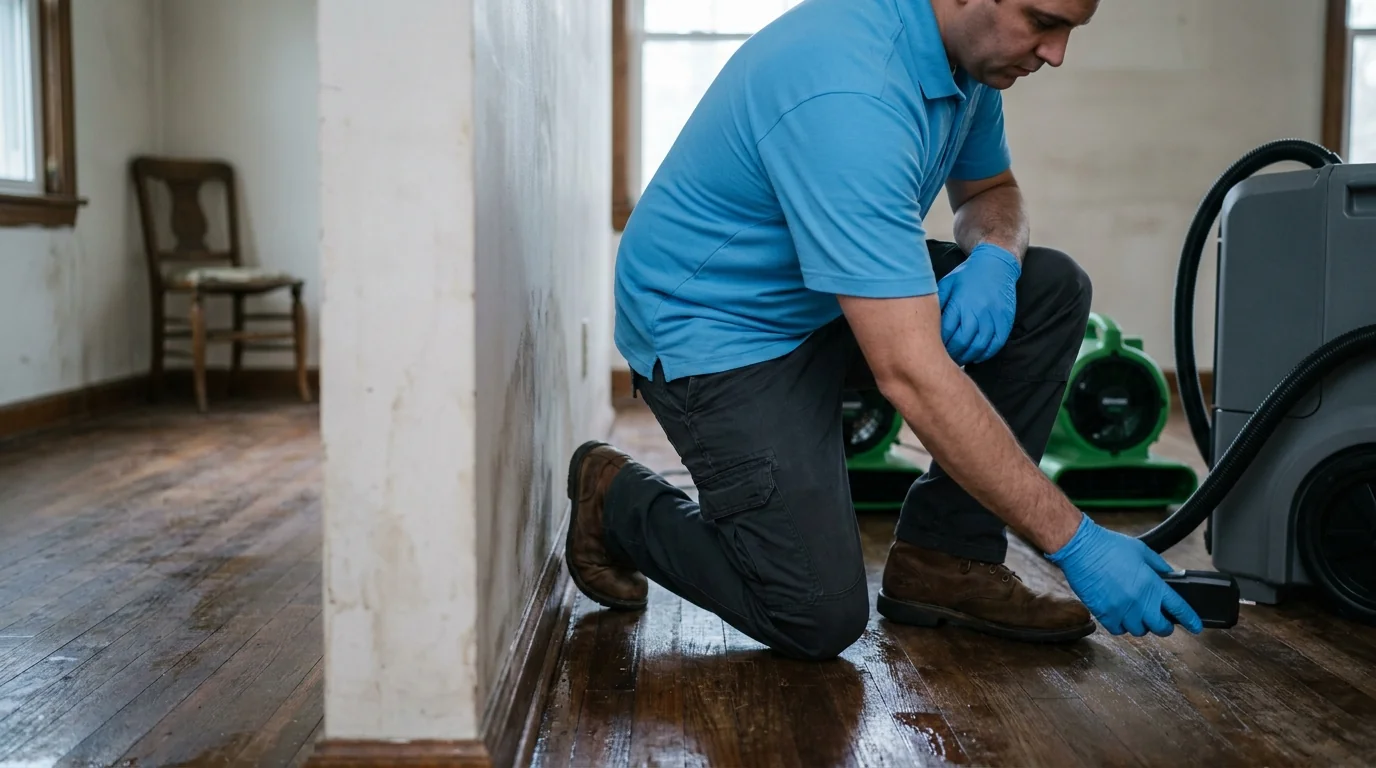
The first visit is about containment and mapping, not just mopping up standing water. We extract free water with truck-mounted and portable equipment, then use moisture meters and thermal imaging to find where water has migrated inside walls, under flooring, and behind cabinetry, because in a high-rise that often means checking the unit below as well as the one with the obvious leak. Structural drying follows the IICRC S500 standard, with air movers and dehumidifiers placed and adjusted based on daily moisture readings rather than a fixed schedule. Concrete slab construction common in Fort Lee’s towers dries slower than wood-frame assemblies, so we extend monitoring rather than pulling equipment early just because surfaces feel dry to the touch. For Coytesville and The Hill properties with plaster walls, we’re more conservative about demolition, since plaster can often be dried in place where drywall would already need to come out.
Fort Lee Insurance & HOA Coordination
Water losses in condo towers almost always involve a conversation between the unit owner’s policy and the building’s master insurance policy, and HOA boards along the Palisades corridor typically want documentation before any drying equipment goes in or demolition starts. We photograph and log moisture readings as we go specifically so that paperwork exists when the adjuster and the HOA property manager both need it. For single-family and multifamily losses in Coytesville, The Hill, and Linwood, the claim is usually more straightforward, but we still document thoroughly since older plumbing failures sometimes raise questions about pre-existing wear versus sudden damage.
Local note
Buildings along the Palisades edge, including stretches near Palisades Interstate Park, often have mechanical rooms and risers that are only accessible through locked utility closets shared by multiple units. On a water call in one of these towers, the fastest move is usually getting the superintendent or HOA property manager on the phone immediately, since shutting off the right riser valve (not just the unit’s own shutoff) is often what actually stops the leak from spreading to units below.
If you’re dealing with standing water, a soaked ceiling, or a slow leak that’s been running longer than you’d like to admit, in a tower near Hudson Lights, a home in Coytesville, or anywhere in between in 07024, call (844) 808-8838. We’re an IICRC Certified Firm and a NJ Licensed Home Improvement Contractor, and we document every step for your insurer or your HOA board as we work.
Serving Fort Lee from our Fair Lawn headquarters — ★ 4.8 · 171 Google reviews
“Honest people, super quick and very professional! I recommend them entirely.” - Jennifer, November 2026Read our reviews on Google →
Water Damage Restoration in Fort Lee: Service Coverage
Frequently Asked Questions
How fast can you arrive for water damage restoration in Fort Lee?
How do you handle water damage in Fort Lee high-rises where the leak source is in a different unit?
Are Coytesville and The Hill homes more prone to water damage from aging plumbing?
Does living near the Palisades affect how fast storm water causes damage in Fort Lee?
How does structural drying differ between a concrete high-rise and a prewar home in Fort Lee, ZIP 07024?
Will my condo association in Fort Lee need documentation before you start drying equipment?
Will my homeowners insurance cover water damage restoration in Fort Lee?
Water Damage Restoration response in Fort Lee
Most Fort Lee calls see a technician on-site within 60 minutes from our Fair Lawn headquarters.