
Mold Remediation in East Orange
24/7 mold remediation in East Orange, NJ. IICRC-certified, insurance billing accepted. Call (844) 808-8838.
Our IICRC-certified technicians are dispatched from our Fair Lawn, NJ headquarters and are typically on-site in East Orange within 60 minutes of your call.
Mold in East Orange rarely starts where you can see it. A slow leak behind a plaster wall in one of the city’s three-story brick walk-ups, or a damp finished cellar near Elmwood after a heavy rain, can colonize a wall cavity before anyone notices a smell. With housing stock running from early-1900s brick apartments to postwar two-families, mold remediation here means working around party walls, shared stacks, and basements that were never built to handle today’s storm volumes.
Why East Orange Properties See Mold Issues
Much of East Orange’s housing was built between the 1900s and 1930s: brick apartment buildings, three-story walk-ups, and classic two-families with cast-iron stacks and galvanized supply risers that are now well past their intended service life. When those risers pinhole inside a wall cavity, the leak often stays hidden behind plaster or lath for weeks, and that’s more than enough time for mold to establish a colony in the wall cavity before a tenant or owner spots staining. Flat roofs on the older brick buildings near Brick Church station and along the Central Avenue corridor add another failure point, since ponding water finds the smallest gap in flashing and tracks downward through multiple floors.
Lower-lying sections of the city, including parts of Doddtown and Elmwood near the Second River tributaries, took on significant water during Ida in 2021, and basements that flooded then are often the same ones that see recurring moisture and musty odors every time there’s a sustained rain event. Finished cellars and basement mechanical rooms throughout the city are particularly exposed, since sump systems and floor drains in older homes weren’t sized for current storm intensity.
Our Mold Remediation Process in East Orange
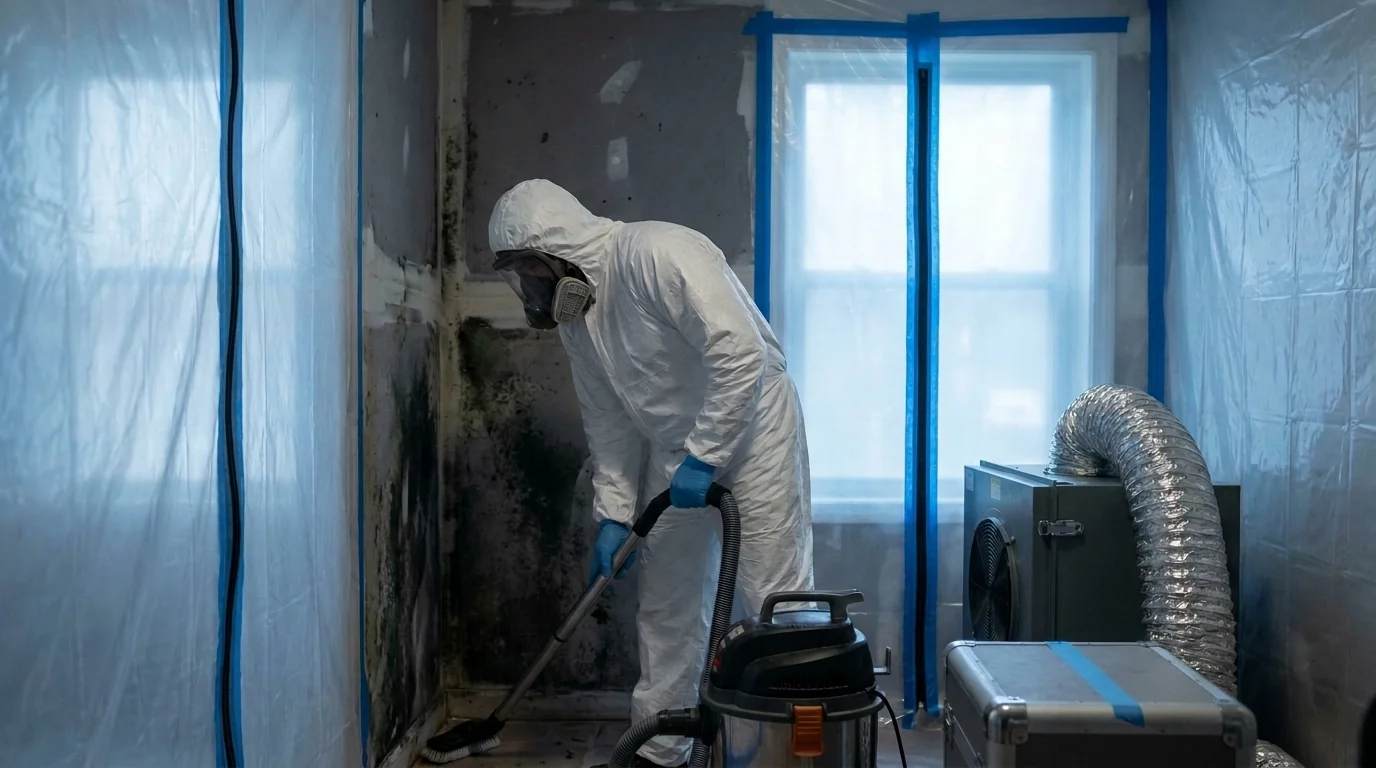
In multi-unit buildings, which make up a large share of East Orange’s housing stock, containment has to account for shared hallways, common ductwork, and party walls that can carry spores into a neighboring unit if containment isn’t sealed correctly. We set up negative air containment at the affected unit’s boundary, run HEPA air scrubbers to control airborne spore counts, and remove porous materials that can’t be cleaned, following the IICRC S520 mold remediation standard for scope and clearance. In buildings near Ampere and Presidential Estates, where units often share a cockloft or attic space above a common flat roof, we check adjoining units as part of the same job rather than treating the visible unit in isolation.
Once the source of moisture is controlled, whether that’s a riser repair, a roof patch, or a basement sump issue, we dry the structure to a stable moisture content before closing out containment, then do a final visual and moisture check before clearing the space for reoccupancy.
Equipment & Methods We Use for Mold
Moisture meters and thermal imaging let us track hidden moisture inside plaster and lath walls without opening every section of drywall, which matters in East Orange’s older buildings where full demo isn’t always practical or necessary. HEPA-filtered vacuums and negative air machines control spore movement during removal, and where a wall cavity needs inspection without a full tear-out, a borescope lets us look inside through a small access hole first. Antimicrobial treatments go on cleaned, dried surfaces only after the moisture source is addressed, since treating an active leak is a short-term fix at best.
Local note
One pattern we watch for specifically in East Orange’s three-story brick walk-ups, especially around Brick Church station and the 07017 area, is a shared cockloft between units under a single flat roof. A roof leak that shows up as a stain in one apartment can be wicking moisture sideways through that shared space into the unit next door, so checking the neighboring ceiling is standard practice even when only one tenant has reported a problem.
Mold remediation in East Orange’s older buildings is as much about stopping the moisture source as it is about cleanup, and that’s a coordination problem as much as a technical one when a building has multiple owners or tenants involved. If you’re dealing with a musty smell, visible growth, or a leak that’s been sitting longer than it should have, call The Restoration Group at (844) 808-8838. We’re IICRC Certified Firm #210213, licensed as a Home Improvement Contractor through the NJ Division of Consumer Affairs, and available 24/7 to get a crew assessing the affected unit or building.
Serving East Orange from our Fair Lawn headquarters — ★ 4.8 · 171 Google reviews
“Everyone was professional. However the communication was not the best.” - Ashley, November 2026Read our reviews on Google →
Mold Remediation in East Orange: Service Coverage
Frequently Asked Questions
How fast can you arrive for mold remediation in East Orange?
How does mold remediation work differently in East Orange's brick walk-up apartments near Brick Church station compared to a single-family home?
Are basement apartments in Elmwood and Doddtown more prone to recurring mold after heavy rain?
How long does containment and remediation typically take for a flat-roof leak in an East Orange multi-unit building?
Will a landlord's insurance or a renter's policy cover mold remediation in an East Orange apartment, like in the 07018 ZIP?
What equipment do you use to find hidden mold inside the plaster walls common in East Orange's older buildings?
Mold Remediation response in East Orange
Most East Orange calls see a technician on-site within 60 minutes from our Fair Lawn headquarters.