Mold Remediation in Clark
24/7 mold remediation in Clark, NJ. IICRC-certified, insurance billing accepted. Call (844) 808-8838.
Our IICRC-certified technicians are dispatched from our Fair Lawn, NJ headquarters and are typically on-site in Clark within 60 minutes of your call.
Mold remediation in Clark usually starts with a call about a smell, not a sight. Someone notices a musty pull near the stairs to a finished basement off Valley Road, or a homeowner near Lake Avenue pulls up carpet after a wet summer and finds the pad gone gray underneath. In a town built mostly on 1950s and 60s ranches and split-levels, that basement is almost always finished living space, and finished space is exactly where mold hides longest before anyone calls.
Why Clark Properties See Mold Growth
Clark’s housing stock runs heavy on postwar ranches, capes, and split-levels, most of them sitting over full basements that were finished decades after the original build. Those basements depend on cast-iron drain lines and copper supply piping that are now well past their intended service life, and when a joint weeps slowly behind a finished wall, nobody notices until the drywall starts to smell. The Rahway River runs along Clark’s northern and western edge, and the Robinson’s Branch tributary cuts through low ground near Lake Avenue, both of which came out of their banks during Ida in 2021 and pushed sewage and groundwater into basements along Valley Road. Even outside of a named storm, a hard summer downpour overwhelms a tired sump pump fast, and a basement that sits wet for more than a day or two is already past the point where surface drying is enough. Mold colonizes framing, subfloor, and insulation within roughly 24 to 48 hours of sustained moisture, and in a finished basement that moisture is usually trapped behind paneling or drywall where it’s invisible until the colony is established.
Our Mold Remediation Process in Clark
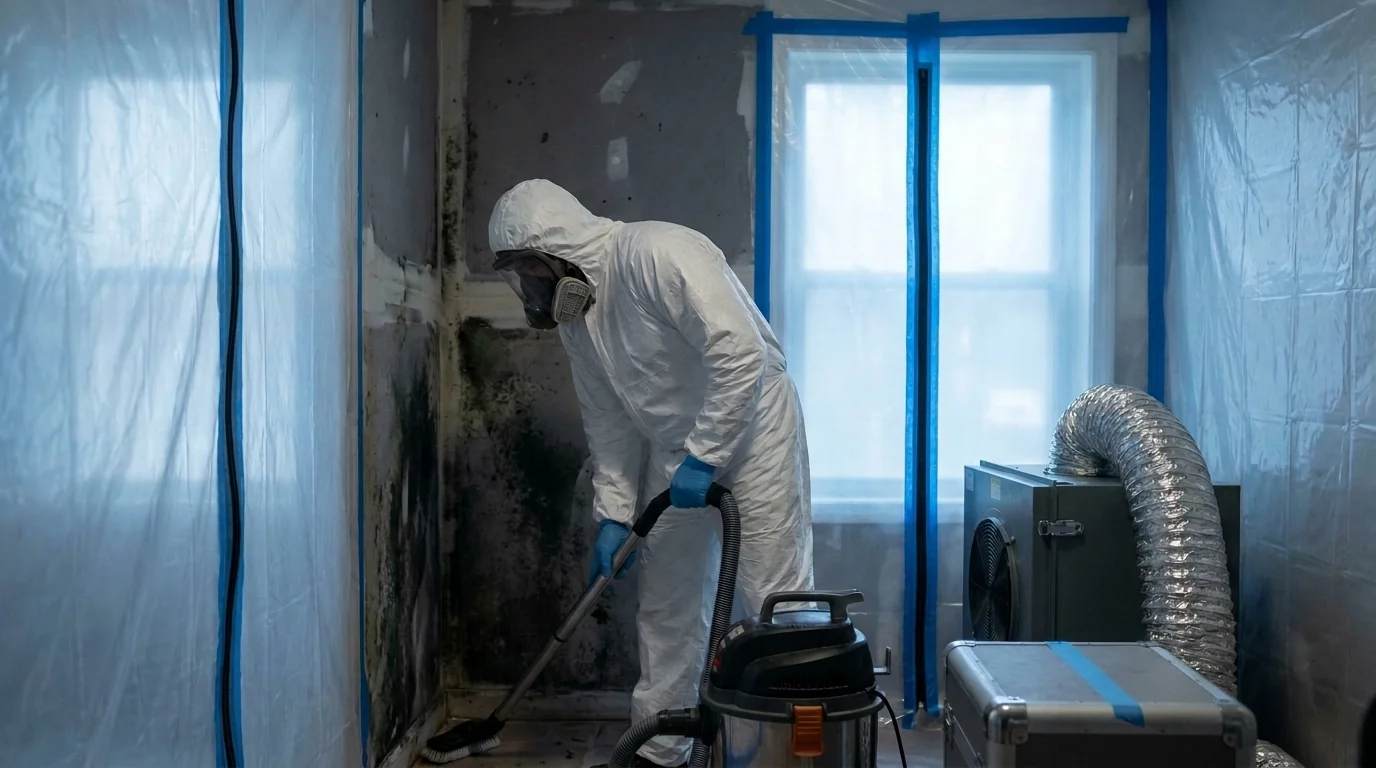
We start with a moisture inspection, not a guess, because a basement that looks dry on the surface can still be saturated in the wall cavity or under the subfloor. Once we confirm the extent of growth, we isolate the work area with physical containment and negative air pressure so spores don’t travel into the rest of the house while we work, which matters more in a split-level where the basement stairwell often opens directly into the main living floor. Affected porous materials like drywall, insulation, and carpet pad get removed and bagged for disposal, while structural wood and subfloor get cleaned, treated, and dried in place following IICRC S520 guidance. We verify the job is done with air and surface testing before we close containment, not just a visual check, because a Clark basement that was damp for a week after a Robinson’s Branch backup needs more than a wipe-down to be safe to finish again.
Clark Insurance & HOA Coordination
Most standard homeowner policies in New Jersey treat mold as excluded unless it results directly from a covered water loss, which is why documentation matters as much as the cleanup itself. If the mold in a Valley Road basement traces back to a sewer backup or sump failure during a storm event, we document the source, the moisture readings, and the affected materials so that paperwork supports a claim instead of raising questions about it. Clark is mostly single-family homes rather than large HOA developments, so most of our coordination here is directly with homeowners and their adjusters rather than a property management board, though we handle the same documentation standard for the handful of condo and townhome clusters near the Westfield Avenue corridor.
Equipment & Methods We Use for Mold
We rely on HEPA-filtered air scrubbers and negative air machines to control airborne spores during removal, moisture meters and thermal imaging to map how far dampness traveled past the visible stain, and EPA-registered antimicrobial treatments on structural surfaces that can be cleaned and saved rather than removed. Containment barriers and controlled air pressure keep the work zone isolated from the rest of the house, which is especially important in split-level layouts where a basement and main floor often share an open stairwell.
Local note
Homes near the Clark Reservation area and the lower ground around Lake Avenue tend to sit on a higher water table than the rest of town, which means a basement there can stay damp for days after a storm even once the visible water is gone. On those jobs we extend drying time and run a second moisture check before we call a space clear, because a quick read that looks dry on day two can still be wicking moisture up through the slab on day five.
If you’re dealing with a musty smell or visible growth in a Clark basement, the sooner it’s assessed, the less material has to come out. Call The Restoration Group at (844) 808-8838 to schedule a mold inspection and get a containment and removal plan built around your home’s specific layout and history.
Serving Clark from our Fair Lawn headquarters — ★ 4.8 · 171 Google reviews
“Everyone was professional. However the communication was not the best.” - Ashley, November 2026Read our reviews on Google →
Mold Remediation in Clark: Service Coverage
Frequently Asked Questions
How fast can you arrive for mold remediation in Clark?
How does Clark's history of Robinson's Branch and Rahway River flooding affect mold risk in basements near Lake Avenue?
Are 1950s and 60s ranches and split-levels in Clark more prone to mold than newer construction?
Does a sewer backup off Valley Road count as a covered loss for mold remediation under my insurance?
What does mold containment actually involve in a Clark split-level with an open basement stairwell?
How long does mold remediation typically take for a finished basement near the Clark Reservation area?
Mold Remediation response in Clark
Most Clark calls see a technician on-site within 60 minutes from our Fair Lawn headquarters.