
24/7 Emergency Water Removal & Cleanup in Brooklyn
24/7 emergency water removal and cleanup in Brooklyn, NY. IICRC-certified, insurance billing accepted. Call (844) 808-8838.
Our IICRC-certified technicians are dispatched from our Fair Lawn, NJ headquarters and are typically on-site in Brooklyn within 60 minutes of your call.
Water pooling in a Park Slope garden-level apartment behaves differently than water pooling in a split-level ranch in the suburbs. In Brooklyn’s brownstone belt, a burst supply line or backed-up drain finds the lowest point fast: the cellar or garden unit below street grade, often carved into a house built decades before that space was ever meant to hold plumbing. The Restoration Group answers 24/7 for emergency water removal and cleanup across Brooklyn, pulling standing water before it wicks upward into joists, plaster, and the lath behind century-old walls.
Why Brooklyn Properties See Water Damage Fast
Most of the brownstone belt, Park Slope, Brooklyn Heights, and the blocks pushing toward Bed-Stuy, was built between the 1880s and 1920s as masonry rowhouses with below-grade cellars and garden-level apartments. Those spaces sit close to the water table and close to aging combined sewer lines, so they’re the first to flood when a storm drain backs up or a cast-iron stack fails. Hurricane Ida’s rainfall turned this into a citywide emergency, with basement and garden-level units across the borough taking on water in a matter of minutes, not hours. Further out, Canarsie and the stretch toward the Coney Island boardwalk carry a different exposure: storm surge. Residents there still measure storms against Sandy, and tidal flooding behaves less like a plumbing failure and more like the bay briefly reclaiming a basement.
Our Emergency Water Removal Process in Brooklyn
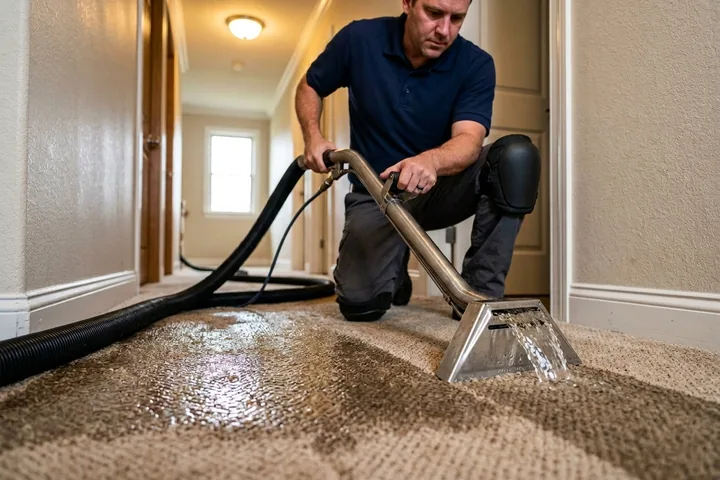
The first call is triage: is this a clean supply line break, a sewer backup, or storm surge intrusion, because each changes the extraction plan and the safety gear our crew wears on-site. In rowhouse basements we extract with portable pumps and truck-mounted units staged on the street, since narrow stoops and tight interior stairwells in buildings near Brooklyn Heights and Williamsburg rarely allow full-size equipment past the front door. Moisture readings get taken at the baseboard, mid-wall, and subfloor, because plaster and old-growth lath hold water differently than the drywall in a newer build, and drying has to be paced to the material, not a generic timeline. Everything is logged and photographed as we go, since that documentation is what makes the difference between a claim that moves and one that stalls.
Brooklyn Insurance and Co-op Board Coordination
A meaningful share of Brooklyn housing stock is co-op or condo, which means a flooded unit often answers to two parties: the owner’s insurer and the building’s managing agent or board. Boards in Park Slope and Brooklyn Heights buildings frequently want their own moisture logs and drying verification before they’ll sign off on repairs to shared walls or risers, separate from whatever the unit owner’s carrier requires. We document for both from day one, including readings on party walls shared with a neighboring unit, so the paperwork doesn’t become the bottleneck after the water is already gone.
Reaching Brooklyn from Fair Lawn
We’re based in Fair Lawn, New Jersey, and reach Brooklyn via the George Washington Bridge and the BQE, or across the Verrazzano corridor for calls in Bay Ridge and points south toward Flatbush and Canarsie. Traffic on those routes is unpredictable at almost any hour, which is exactly why we start staging equipment and routing a crew the moment a call comes in rather than waiting on a scheduled window.
Local note
Party walls in Brooklyn’s attached rowhouses share more than a property line, they often share moisture. Water that saturates a cellar wall in a Park Slope brownstone can migrate laterally into the adjoining building before it ever shows as a stain on either side, which is why we check the neighbor-facing wall even on a call that looks contained to one address. It’s a detail that matters in attached housing and almost never comes up on a detached single-family job.
If water is spreading across a cellar floor, pooling under a garden-level unit, or backing up through a floor drain anywhere from Bay Ridge to Bushwick, call The Restoration Group at (844) 808-8838. We answer 24/7 for emergency water removal and cleanup across Brooklyn and get extraction equipment moving before the damage climbs past the baseboards.
Serving Brooklyn from our Fair Lawn headquarters — ★ 4.8 · 171 Google reviews
“I had a very positive experience working with The Restoration Group. From the beginning, their team was professional, responsive, courteous, and attentive to my concerns. They took the time to explain the restoration process, answer my questions, and make sure I understood each step along the way…” - Cindy, November 2026Read our reviews on Google →
Emergency Water Removal & Cleanup in Brooklyn: Service Coverage
Frequently Asked Questions
How fast can you arrive for emergency water removal & cleanup in Brooklyn?
How fast can a crew reach a garden-level flood in Park Slope or Brooklyn Heights?
Do Brooklyn co-op and condo boards require specific documentation for water extraction?
Are Canarsie and other coastal Brooklyn neighborhoods more prone to this kind of flooding?
How does extraction work in a brownstone with a narrow stairwell?
Will flooding in one brownstone unit affect the attached neighbor's wall?
Will my homeowners insurance cover emergency water removal & cleanup in Brooklyn?
Emergency Water Removal & Cleanup response in Brooklyn
Most Brooklyn calls see a technician on-site within 60 minutes from our Fair Lawn headquarters.