Flood Damage Restoration in Bayonne
24/7 flood damage restoration in Bayonne, NJ. IICRC-certified, insurance billing accepted. Call (855) 650-7422.
Our IICRC-certified technicians are dispatched from our Fair Lawn, NJ headquarters and are typically on-site in Bayonne within 60 minutes of your call.
Bayonne sits on a narrow peninsula wedged between Newark Bay and the Kill Van Kull, and that geography has consequences every time a nor’easter stalls over the harbor or a storm surge pushes inland the way Sandy did in 2012. When floodwater reaches the finished basements and ground-floor units of the borough’s dense early 20th-century two- and three-family homes, it moves fast, and the clock on mold colonization starts within 24 to 48 hours of saturation. The Restoration Group responds around the clock, dispatching IICRC Certified Firm (#210213) crews to Bayonne addresses in ZIP code 07002 whenever the call comes in.
Why Bayonne Properties See Flood Damage Differently
The same peninsula shape that gives Bayonne its waterfront character also concentrates flood risk in ways that don’t apply to inland New Jersey towns. The low-lying blocks near Constable Hook and the Newark Bay waterfront sit at or barely above sea level, making them the first to receive storm surge and the last to drain. But flooding here isn’t only a coastal story.
The borough’s housing stock is overwhelmingly pre-1950 construction, brick rowhomes, frame two-families, and postwar capes, most of them built over finished basements with cast-iron floor drains and original galvanized or lead supply lines that are quietly failing on schedule. A single supply-line rupture overnight can dump hundreds of gallons into a finished basement before a tenant notices. Dense rental occupancy means losses often go unreported for hours, and shared walls between attached homes mean water migrates laterally into neighboring units before anyone calls.
The Route 440 corridor and Bayonne Crossing retail center add a commercial dimension: sprinkler activations, overnight roof leaks, and HVAC condensate failures in large-footprint retail spaces require high-volume extraction equipment that residential-only contractors don’t carry.
Our Flood Damage Restoration Process in Bayonne
Every flood loss is different, but the sequence that produces a dry, documented, insurer-ready result is consistent.
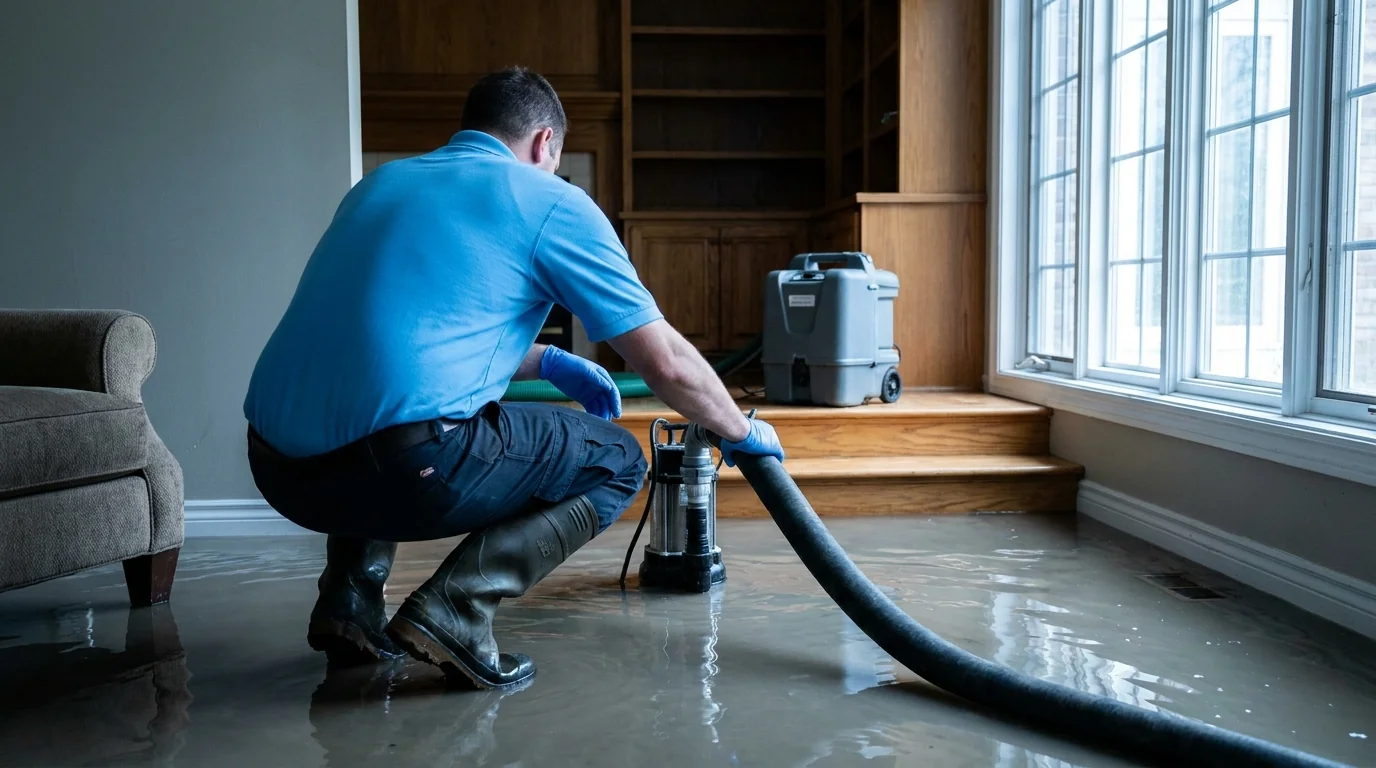
Rapid water extraction comes first. Truck-mounted and portable extractors pull standing water from basements, crawl spaces, and slab-on-grade areas. In Bayonne’s older homes, cast-iron drain systems sometimes back up during heavy rain events, so we assess drainage before extraction to avoid pushing water toward a blocked outlet.
Moisture mapping follows immediately. Thermal imaging and calibrated moisture meters trace water migration through original plaster walls, tongue-and-groove subfloors, and the brick-and-mortar assemblies common in Bergen Point and Downtown Bayonne rowhouses. Water hides in cavities that look dry on the surface.
Structural drying uses industrial desiccant and refrigerant dehumidifiers alongside high-velocity air movers, positioned according to psychrometric calculations rather than guesswork. Drying logs are recorded daily, documentation your adjuster will need.
Antimicrobial treatment addresses any microbial growth that established itself during the saturation window. We do not make health claims about air quality, but we apply EPA-registered products to affected surfaces as a standard step.
Controlled demolition, when necessary, removes saturated materials, wet insulation, buckled flooring, compromised drywall, that cannot be dried in place. Scope is documented photographically before anything is removed.
Reaching Bayonne from Kenilworth
The Restoration Group’s operations hub is in Kenilworth, NJ. Crews travel to Bayonne via the New Jersey Turnpike and Route 440, a route that stays navigable even during weather events that close secondary roads. Because Bayonne’s street grid is tight, particularly around Stephen R. Gregg Park and the Uptown residential blocks, lead crews confirm parking and equipment staging before arrival on large jobs. For multi-unit buildings or commercial properties near the Bayonne Bridge approach, we coordinate with building management on access points in advance. Our hours are 24/7, so a call at 2 a.m. after a basement floods during a tidal surge gets the same response as a weekday morning pipe break.
Bayonne Insurance Coordination
Most flood losses in Bayonne involve at least two coverage questions: the homeowner’s or landlord’s property policy and, for properties in designated flood zones near the Newark Bay waterfront, a separate NFIP (National Flood Insurance Program) flood policy. These two policies cover different line items and have different documentation requirements. We photograph affected materials before removal, generate moisture logs that meet adjuster standards, and provide itemized scope-of-loss reports formatted for direct submission. We bill carriers directly and work to keep out-of-pocket exposure as low as the policy allows.
Local Note
One pattern that catches Bayonne homeowners off guard: the original plaster-on-wood-lath walls in pre-war two- and three-families absorb water more slowly than modern drywall, but they release it more slowly too. A wall that reads wet on a moisture meter after extraction may still be releasing vapor three or four days into the drying cycle. Crews who aren’t tracking psychrometrics daily will pull equipment too early, leave residual moisture in the assembly, and set up conditions for mold behind intact plaster. We extend drying cycles in these homes and verify with final moisture readings before closing out, a step that matters especially in the dense attached housing around Bergen Point, where a wall is often shared with a neighbor who has no idea a loss occurred next door.
If your home or property in Bayonne has taken on water, whether from a storm surge, a failed supply line, or a backed-up drain, call The Restoration Group at (855) 650-7422. We’ll assess the damage, start extraction, and walk you through every step from wet floors to a documented, dry close-out.
Serving Bayonne from our Fair Lawn headquarters — ★ 4.8 · 160 Google reviews
“(Translated by Google) Excellent work. The staff were responsible, friendly, and above all, very clean. I was very satisfied and I recommend them 100%. (Original) Excelente trabajo.el personal responsables,amables y sobre todo muy limpios para trabajar .quedé satisfecha y lo recomiendo al 💯.” — Dessy, September 2026Read our reviews on Google →
Flood Damage Restoration in Bayonne: Service Coverage
Frequently Asked Questions
How fast can you arrive for flood damage restoration in Bayonne?
How quickly can The Restoration Group reach a flooded basement in Bayonne's Constable Hook or Bergen Point neighborhoods?
Bayonne has a lot of older two- and three-family homes with finished basements — does that affect how long flood drying takes?
My Bayonne property is in a flood zone near Newark Bay — does that mean I need a separate flood insurance policy, and how does that affect the restoration claim?
What's the risk of mold after a flood in a Bayonne rowhouse, and how fast does it develop?
Does Bayonne's dense rental housing stock create any complications for flood restoration in multi-unit buildings?
Flood Damage Restoration response in Bayonne
Most Bayonne calls see a technician on-site within 60 minutes from our Fair Lawn headquarters.