
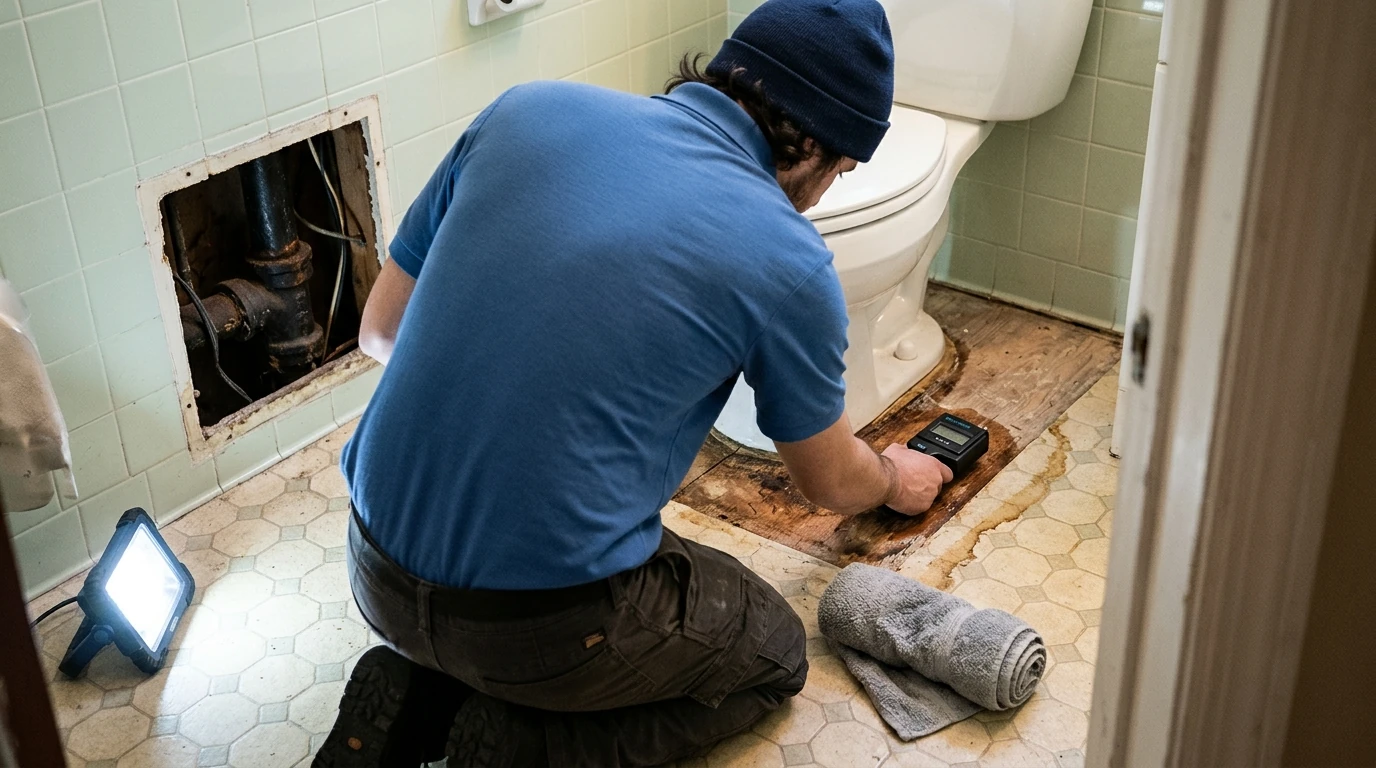
TL;DR: For a toilet overflow in Fair Lawn, NJ, call a plumber if it’s a running fill valve or a clog you’ve already stopped at the shutoff and the water never left the bathroom floor. Call a restoration company immediately if the water soaked the subfloor, dripped through the ceiling below, or came from the bowl rather than the clean tank. A plumber fixes the fixture. A restoration crew dries the structure before mold starts, which the EPA says can begin within 24 to 48 hours on a wet material.
If this just happened in a Radburn colonial or a postwar cape near Warren Point, the water is probably already past the bathroom door by the time you’re reading this. Here’s the fast version: shut the water off at the valve behind the toilet, then call a plumber for the fixture itself. Call The Restoration Group at (844) 808-8838 if water reached the subfloor, dripped into the ceiling below, or came from the bowl instead of the tank; the crew holds IICRC Certified Firm status (#210213) and answers 24/7.
Plumber or Restoration Company: Which Do I Call First?
Call a plumber first when the problem is still mechanical and contained: a stuck flapper, a bad fill valve, or a clogged drain, with water still confined to the bathroom floor. A plumber’s job is to stop the water from coming back, not to dry out what’s already wet.
Call a restoration company first, or at the same time, when the water has already left the bathroom. That means it reached the hallway, soaked baseboards or the subfloor under the toilet, or showed up as a stain or drip on the ceiling of the room below. In 1920s-30s Radburn homes and the postwar capes common across Fair Lawn, subfloor and cast-iron drain lines are original or close to it, and water finds gaps fast once it’s past the wax ring or the base of the bowl.
Either way, the very first move is physical, not a phone call: shut off the supply valve behind the toilet. That stops active flow in seconds and buys time to make the right second call.
Recent job photo from The Restoration Group.
Is Toilet Overflow Water Clean, or Is It Sewage?
It depends on where the water came from, not on how much of it there is. If the overflow is the tank refilling and spilling over the rim before it ever touched the bowl, that’s Category 1, a clean supply-line source under the IICRC S500 standard.
If bowl water overflowed from a clog, that’s Category 2 at minimum, even with no visible solid waste. If the backup is coming up from the drain line, beyond the trap, or carries any solid waste, that’s Category 3, the same classification as a sewer backup, and it calls for antimicrobial treatment and PPE, not just towels and a fan. If you’re also dealing with water backing up from a floor drain or another fixture, our guide to who to call for a sewer backup in Fair Lawn walks through that scenario specifically.
What Does a Restoration Crew Actually Do on the First Visit?
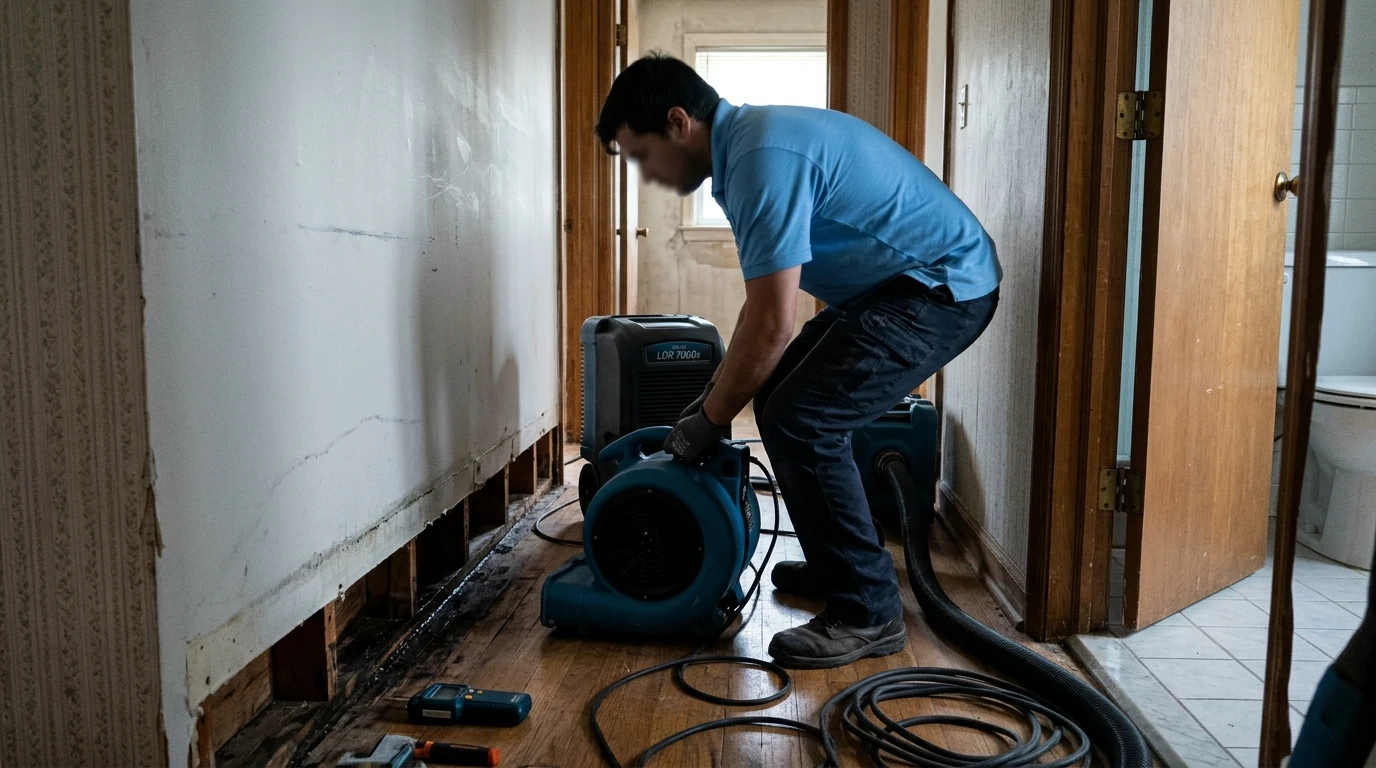
The first visit is assessment and extraction, not guesswork. A technician uses a moisture meter to map how far the water traveled under the flooring and into the subfloor, since drywall and subfloor can look dry on the surface while still holding water underneath.
From there: standing water gets extracted, affected baseboards or flooring are pulled if they’ve absorbed water past the point of drying in place, and air movers plus a dehumidifier go in to dry the structure to the IICRC S500 standard. If water reached the ceiling of the room below, that ceiling gets checked and documented too; our ceiling water damage guide covers when a stained ceiling can be patched versus when it has to come down. Everything gets photographed and logged for the insurance file before any material is removed.
Will Homeowners Insurance Pay for This?
Most homeowners policies cover sudden, accidental water damage, which typically includes a toilet that overflows once from a mechanical failure like a bad fill valve or a clog. What they typically exclude is water backing up from a sewer or drain line, which needs a separate water backup endorsement, and gradual leaks from long-term neglect.
That distinction matters here: a one-time overflow from a failed part usually falls under standard coverage per the Insurance Information Institute, but water that backed up into the toilet from the drain system is a different coverage question entirely. Documenting the source and the timeline, photos, the shutoff time, what the water looked like, protects the claim either way. No restoration company can promise an outcome on a claim; that decision belongs to the adjuster and the policy language.
If the overflow soaked carpet, drywall, or a finished ceiling and you’re not sure whether this is a same-day DIY job or a call worth making, Call The Restoration Group at (844) 808-8838 for a water damage assessment before more of the structure absorbs it.